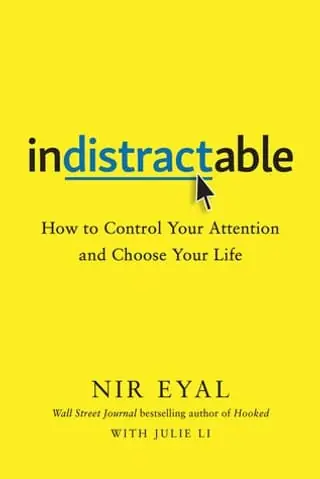
Indistractable summary
by Nir Eyal · 2019 · 7 key ideas · 17-minute read
Distraction starts inside us, so master the uncomfortable feelings that drive it, plan time for what matters, cut unhelpful triggers and use pacts to stay on track.
Why read it
For anyone who blames their phone for lost hours but suspects the problem runs deeper. It offers a clear four-part model and plenty of practical tactics without asking you to quit technology.
Indistractable in brief
Eyal starts with a reframing. The opposite of distraction isn't focus; it's traction, meaning any action that moves you toward what you said you wanted to do. Distraction is anything that pulls you away from it. Crucially, the same activity, such as checking social media, can be traction if you planned it and distraction if you didn't.
His central claim is that most distraction is driven by internal triggers: uncomfortable feelings such as boredom, anxiety, loneliness or uncertainty. We reach for our phones to escape those feelings. Technology is a proximate cause; the root cause is how we handle discomfort. So time management, he argues, is really pain management.
The book offers a four-part model. Master internal triggers by learning to sit with and reframe discomfort. Make time for traction by planning your days according to your values with timeboxing. Hack back external triggers, the pings, emails and meetings that interrupt you. And prevent distraction with pacts, precommitments that make it harder to slip.
Eyal then applies the model to workplaces, which he argues often cultivate distraction through their culture, and to children and relationships. The overall promise: anyone can become 'indistractable', doing what they say they will do.
The 7 key ideas
1. Traction vs distraction
Without a plan, everything is a distraction.
2. Time management is pain management
Fix the feeling, not just the phone.
3. Reimagine the trigger, task and temperament
Ride the urge for ten minutes; it usually passes.
4. Timebox your values
If it isn't in the calendar, it isn't a priority.
5. Hack back external triggers
Is this trigger serving me, or am I serving it?
6. Make pacts
Decide once, in advance, and let the pact do the work.
7. Indistractable workplaces
Distracted teams are often unsafe teams.
Read the full guide in Kinquire. Every idea with a real example, a diagram and one thing to try today, plus a quick quiz so it sticks. Free to start.
Read IndistractableKey takeaways
- Plan your day in advance so you can tell traction from distraction.
- Notice and name the feeling that comes before each distraction.
- Use the 10-minute rule to surf urges before giving in.
- Timebox your week across You, Relationships and Work.
- Turn off non-essential notifications and set up at least one pact.
Our take
Indistractable is practical, well organised and kinder than most anti-tech books; its key insight, that distraction is often about escaping feelings, is useful and widely echoed. Its weakness is that it can shift too much responsibility onto individuals when apps are deliberately designed to capture attention, an irony given Eyal's earlier book Hooked. Some cited research, especially on willpower and mindset, is less solid than presented. As a toolkit, though, the four-part model of internal triggers, timeboxing, external triggers and pacts is clear and easy to apply.
About Nir Eyal
Nir Eyal is an author and former lecturer at Stanford's Graduate School of Business. He is best known for his earlier book Hooked, about how companies build habit-forming products.
If you liked this
- Hooked by Nir Eyal
- Digital Minimalism by Cal Newport
- Deep Work by Cal Newport
- Four Thousand Weeks by Oliver Burkeman
- Atomic Habits by James Clear
- The Power of Habit by Charles Duhigg