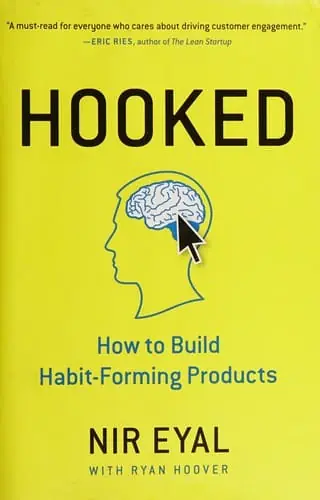
Hooked summary
by Nir Eyal · 2014 · 7 key ideas · 18-minute read
Habit-forming products move users through a repeating loop — trigger, action, variable reward, investment — until using them becomes automatic.
Why read it
For product builders who want people to come back without constant advertising, and for anyone curious about why their phone is so hard to put down. It also asks when designing habits becomes manipulation.
Hooked in brief
Why do we check certain apps dozens of times a day without deciding to? Nir Eyal argues that the most successful consumer products don't rely on expensive advertising to bring people back. They create habits — behaviours done with little or no conscious thought — and habits are a powerful business advantage, raising customer lifetime value and making it hard for rivals to lure users away.
Eyal's Hook Model describes how such habits form. A trigger prompts the user to act. The action is made as easy as possible. A variable reward satisfies the user while leaving them wanting more. Finally, the user makes a small investment — data, content, effort — that improves the product and loads the next trigger. Each pass through the loop makes the next one more automatic.
Over time, external triggers like notifications give way to internal ones: feelings such as boredom, loneliness or uncertainty that the product reliably relieves. At that point the user reaches for the product on their own, with no reminder needed. The product has become the default answer to a feeling, which is the real meaning of being “hooked”.
Eyal ends with ethics. He offers a Manipulation Matrix, asking whether the maker would use the product and whether it materially improves users' lives, and a simple testing method for finding and strengthening the habits a product actually creates. The tools are the same either way; what matters is what they are used for.
The 7 key ideas
1. Habits are a business moat
The best products become itches they scratch.
2. Triggers: from outside to inside
External triggers start habits. Internal triggers keep them.
3. Action: make it ridiculously easy
Don't push motivation. Remove friction.
4. Variable rewards keep us coming back
Not knowing is the hook.
5. Investment: users build their own hook
The more you put in, the harder it is to leave.
6. The Manipulation Matrix
Build habits you'd want for your own family.
7. Habit testing: find and strengthen the loop
Don't guess the habit — find it in the data.
Read the full guide in Kinquire. Every idea with a real example, a diagram and one thing to try today, plus a quick quiz so it sticks. Free to start.
Read HookedKey takeaways
- Find the emotion your users feel just before they need your product.
- Remove one step of friction from your core action.
- Match rewards to why people came, and keep some variability.
- Ask for a small investment right after the reward, not before.
- Check your product honestly against the Manipulation Matrix.
- Use the loop on yourself: pair a good habit with a frequent feeling.
Our take
Hooked gives a clear, practical model of how consumer apps build repeat use, and its Hook Model has become standard vocabulary in product teams. Its strengths are simplicity and concrete design levers. Its weaknesses: evidence is mostly illustrative cases rather than tests of the full model, and the ethics section relies heavily on makers judging themselves. Since publication, concern about compulsive phone use has grown, and many readers now see the book as both a design manual and a warning label. Eyal's own follow-up, Indistractable, addresses the user side.
About Nir Eyal
Nir Eyal is a writer and former lecturer at Stanford's Graduate School of Business who has written widely on technology, psychology and business. He later wrote Indistractable, about resisting the very habits Hooked describes.
If you liked this
- Indistractable by Nir Eyal
- Atomic Habits by James Clear
- The Power of Habit by Charles Duhigg
- Tiny Habits by BJ Fogg
- Zero to One by Peter Thiel with Blake Masters
- The Lean Startup by Eric Ries