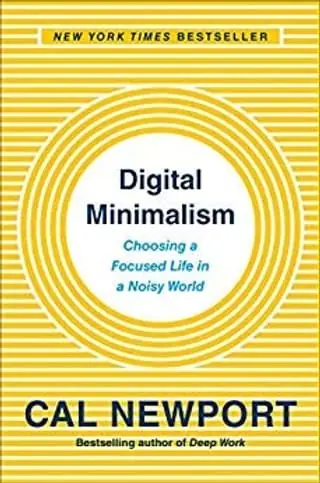
Digital Minimalism summary
by Cal Newport · 2019 · 7 key ideas · 17-minute read
Use technology deliberately: keep only the few tools that strongly support what you value, and happily miss out on everything else.
Why read it
For anyone who feels their phone is using them rather than the other way round. Instead of tips for cutting screen time, it offers a full philosophy and a 30-day reset.
Digital Minimalism in brief
Newport argues that our trouble with technology isn't about willpower. Many apps and platforms are designed to capture as much attention as possible, using psychological hooks such as unpredictable rewards and our hunger for social approval. It's a lopsided arms race, and small tweaks like turning off a few notifications rarely work.
He proposes a philosophy instead: digital minimalism. Focus your online time on a small number of carefully chosen activities that strongly support things you value, and happily miss out on the rest. It rests on three principles: clutter is costly, optimisation matters, and intentionality is satisfying in itself.
To get there, Newport suggests a 30-day digital declutter. Take a break from optional technologies, use the time to rediscover meaningful offline activities, then reintroduce only the tools that pass a strict test, with clear rules for how you'll use them.
The second half of the book offers practices for living this way: protect regular solitude, value real conversation over likes and comments, build high-quality leisure that involves effort and craft, and use specific tactics to keep the attention economy at arm's length.
The 7 key ideas
1. A lopsided arms race
It's not weakness. It's a slot machine in your pocket.
2. The minimalist philosophy
Free apps are paid for in hours of your life.
3. The 30-day declutter
Step back, rediscover, return with rules.
4. Protect your solitude
Alone with your thoughts is where you meet yourself.
5. Conversation over connection
A like is a nod. A call is a conversation.
6. Reclaim leisure
Fill the void before you remove the phone.
7. Join the attention resistance
Make your phone a tool again, not a slot machine.
Read the full guide in Kinquire. Every idea with a real example, a diagram and one thing to try today, plus a quick quiz so it sticks. Free to start.
Read Digital MinimalismKey takeaways
- Try a 30-day break from optional technologies, then reintroduce with rules.
- Take regular walks without your phone or headphones.
- Replace likes and comments with calls and meetings.
- Build demanding, hands-on and social leisure.
- Move social apps off your phone and read news in one daily session.
Our take
Digital Minimalism is persuasive and practical, and the 30-day declutter gives readers a concrete starting point rather than vague advice. Its blind spots: some readers depend on social platforms for work, community or support in ways Newport underplays, and his strict rules can feel austere. The research on social media's harms is more contested than the book sometimes suggests. Still, its central framing, start from your values and choose tools accordingly, has aged well as concern about attention and phones has grown.
About Cal Newport
Cal Newport is a computer science professor at Georgetown University. He is also the author of Deep Work and has famously never had a social media account.
If you liked this
- Deep Work by Cal Newport
- Indistractable by Nir Eyal
- Atomic Habits by James Clear
- The Power of Habit by Charles Duhigg
- The 7 Habits of Highly Effective People by Stephen R. Covey
- Mindset by Carol S. Dweck