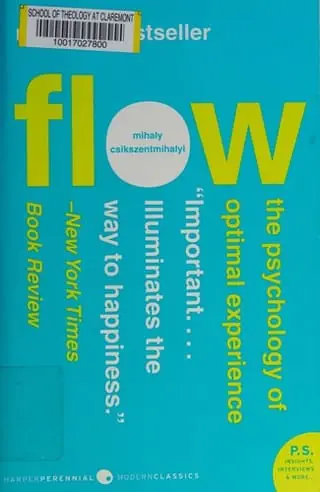
Flow summary
by Mihaly Csikszentmihalyi · 1990 · 8 key ideas · 21-minute read
The best moments of life aren't passive or relaxing; they happen when we stretch body or mind to accomplish something difficult and worthwhile, and we can learn to create them.
Why read it
For anyone who feels their days slip by in distraction or boredom. It explains what makes experiences deeply satisfying and how to bring that state into work, hobbies and relationships.
Flow in brief
Csikszentmihalyi asks what makes life worth living, and his answer comes from decades of interviews and studies with surgeons, rock climbers, chess players, factory workers and many others. Across cultures, people describe their best moments in similar terms: complete absorption in a challenging activity, where time distorts and self-consciousness fades. He calls this flow.
Flow, he argues, is a matter of controlling consciousness. Attention is our most precious resource; when outside threats or inner worries scatter it, we feel disorder. When it is focused on clear goals with immediate feedback, and challenges match our skills, experience becomes ordered and deeply enjoyable.
Crucially, flow isn't the same as pleasure. Pleasure restores us when a need is met; enjoyment, which comes from flow, stretches us and makes us grow. Because skills improve with practice, the challenges must keep rising too, so flow pushes the self to become more complex over time: more skilled and individual, yet more connected to others.
The book then shows how flow can be found almost anywhere: in sport, music, conversation, thinking and, surprisingly, in work, where people report flow more often than in their leisure time. The main obstacle, Csikszentmihalyi argues, is less our circumstances than the way we approach them, because almost any activity can be given goals, rules and feedback.
Finally, he argues that people with an autotelic personality, who enjoy activities for their own sake, can turn even illness or hardship into a set of challenges. And a whole life can become one unified flow experience when its many separate goals are tied together by a meaningful purpose that a person has chosen and pursues with resolve.
The 8 key ideas
1. Control your attention, control your life
Where attention goes, your life goes.
2. Pleasure restores; enjoyment grows you
Pleasure fills you up. Enjoyment builds you up.
3. The ingredients of flow
Goals, feedback, focus: build the game into the task.
4. Stay in the channel between boredom and anxiety
Bored? Raise the bar. Anxious? Build the skill.
5. The paradox of work
Free time isn't automatically good time.
6. Turn routine into a game
No game in the task? Invent one.
7. Build an autotelic self
Can't change the situation? Change it into a challenge.
8. Make your whole life one flow
Connect the goals, and life becomes the activity.
Read the full guide in Kinquire. Every idea with a real example, a diagram and one thing to try today, plus a quick quiz so it sticks. Free to start.
Read FlowKey takeaways
- Guard your attention: it is the raw material of your experience.
- Swap some passive pleasure for active enjoyment each week.
- Give tasks clear goals, feedback and a time limit to invite flow.
- When bored, raise the challenge; when anxious, build skill or shrink the step.
- Turn routine chores into games you can win.
- Write down a life theme and connect daily goals to it.
Our take
Flow is a landmark that gave a name and a scientific shape to something people had always felt, and it influenced education, sport, game design and the workplace. Its strengths are vivid testimony and a clear model. Its weaknesses: it is long and sometimes abstract, with big claims about culture and history that go beyond the data. Later research supports flow as a real, beneficial state but finds it hard to measure, and notes that the simple challenge-skill balance doesn't always predict it. Csikszentmihalyi's suggestion that anyone can find flow anywhere also underplays how much circumstances, like exhausting or insecure work, can limit it.
About Mihaly Csikszentmihalyi
Mihaly Csikszentmihalyi was a Hungarian-American psychologist who taught for many years at the University of Chicago and later at Claremont Graduate University. He is regarded as one of the founders of positive psychology and died in 2021.
If you liked this
- Drive by Daniel H. Pink
- Deep Work by Cal Newport
- The Happiness Hypothesis by Jonathan Haidt
- Man's Search for Meaning by Viktor E. Frankl
- Thinking, Fast and Slow by Daniel Kahneman
- Predictably Irrational by Dan Ariely