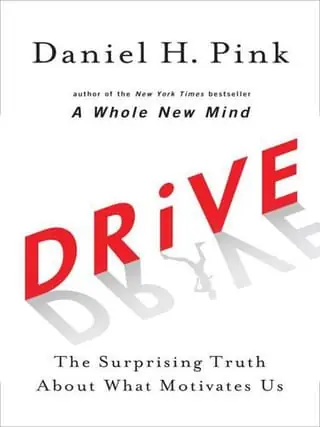
Drive summary
by Daniel H. Pink · 2009 · 8 key ideas · 20-minute read
Carrots and sticks work for simple, routine tasks but often backfire for creative ones; people do their best work when they have autonomy, mastery and purpose.
Why read it
For managers, parents, teachers and anyone trying to motivate themselves. It challenges the reflex to reach for bonuses and penalties, and offers a better toolkit.
Drive in brief
Pink argues that businesses run on an outdated idea of motivation. Most organisations assume people are driven mainly by rewards and punishments: pay for performance, bonuses, targets, penalties. He calls this Motivation 2.0. It worked reasonably well for routine industrial work, but for today's creative, complex jobs, it often fails.
Drawing on decades of research, much of it from psychologists Edward Deci and Richard Ryan, Pink shows that 'if-then' rewards can reduce intrinsic motivation, narrow focus, crush creativity and encourage shortcuts. They still have a place for simple, routine tasks, but leaders overuse them.
The alternative, Motivation 3.0, builds on our innate drive to direct our own lives, get better at things that matter and connect to something larger. Pink calls these autonomy, mastery and purpose. People who are fuelled more by these intrinsic rewards (he calls this Type I behaviour) tend to perform better over time and are healthier and more satisfied.
The second half of the book shows how to build each element in practice: giving people more control over their task, time, technique and team; designing challenges that lead to flow and, over years, to real mastery; and connecting everyday work to a purpose beyond profit, so that people know who their effort helps and why it matters.
A final toolkit offers practical exercises for individuals, organisations, parents and educators. Pink's overarching message is that what science knows about motivation and what business actually does have drifted far apart, and that closing this gap could make work both more productive and more humane for the people doing it.
The 8 key ideas
1. Upgrade to Motivation 3.0
People aren't just horses. Stop leading with carrots.
2. Rewards can backfire on creative work
Carrots focus the mind. Creative work needs it wide open.
3. The Sawyer Effect
Pay for play, and play becomes work.
4. Use 'now that' rewards, not 'if-then'
Reward after, not before. Praise the how.
5. Take money off the table
Pay fairly, then stop talking about pay.
6. Autonomy: the four Ts
Task, time, technique, team: who decides?
7. Mastery is a mindset, a pain and an asymptote
You'll never arrive. That's the point.
8. Purpose: work for something bigger
Profit is a means. Purpose is the engine.
Read the full guide in Kinquire. Every idea with a real example, a diagram and one thing to try today, plus a quick quiz so it sticks. Free to start.
Read DriveKey takeaways
- Use 'if-then' rewards only for routine tasks, and explain why the work matters.
- Prefer unexpected, specific praise to promised bonuses for creative work.
- Pay fairly, then stop using money as the main motivator.
- Look for more control over task, time, technique or team.
- Seek 'Goldilocks tasks' that stretch you just beyond your current skill.
- Connect your work to who it helps.
Our take
Drive is a clear, persuasive popularisation of self-determination theory, and its core claims, that intrinsic motivation matters and that rewards can backfire, rest on real research. Its weaknesses: it simplifies a contested literature, glossing over decades of debate about when and how much rewards undermine motivation. Some studies it cites are small or lab-based, and growth mindset and grit have since faced replication problems. It is also written mainly for knowledge workers with decent pay and some control; for many jobs, autonomy and purpose are harder to come by. Still, as a challenge to reflexive carrots and sticks, it remains valuable.
About Daniel H. Pink
Daniel H. Pink is an American author who earlier served as chief speechwriter for US Vice President Al Gore. His other books include A Whole New Mind and To Sell Is Human.
If you liked this
- Flow by Mihaly Csikszentmihalyi
- Mindset by Carol S. Dweck
- Grit by Angela Duckworth
- Predictably Irrational by Dan Ariely
- Thinking, Fast and Slow by Daniel Kahneman
- The Happiness Hypothesis by Jonathan Haidt