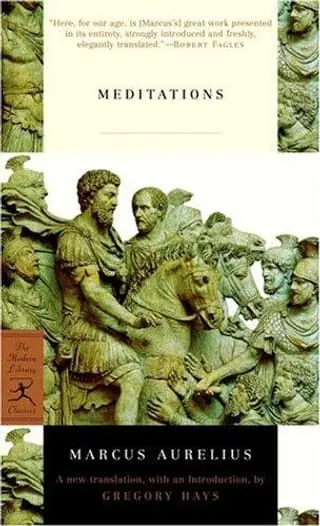
Meditations summary
by Marcus Aurelius · 180 · 7 key ideas · 21-minute read
The private notebook of a Roman emperor training himself, day after day, to stay calm, fair and useful in a world he could not control.
Why read it
For anyone who wants a practical, humane guide to handling stress, difficult people and their own ego. It reads less like a lecture and more like overhearing a wise person talk himself through a hard day.
Meditations in brief
Meditations is not a book in the usual sense. It is a set of twelve short notebooks in which Marcus Aurelius, the most powerful man in the Roman world, reminds himself how to live. There is no plot and no tidy argument. The same handful of ideas return again and again, rephrased, because he was using writing as a daily exercise to keep them alive in his mind.
It opens with gratitude: a list of what he learned from family, teachers and his adoptive father, Antoninus Pius. From there the notes circle a core Stoic insight. Events themselves cannot harm your character; what disturbs you is the judgment you add to them. Your opinions, choices and actions are yours to govern. Almost everything else, from your health to your reputation, is not.
Marcus applies this to ordinary troubles. He prepares each morning to meet rude and ungrateful people without anger, because they act out of ignorance and we are made to work together. He strips grand things down to their plain physical facts so they lose their false glamour. He reminds himself constantly that everything, including emperors and their fame, passes quickly.
None of this is meant to make him passive. The goal is to act well: to do the job in front of him justly, carefully and for the common good, without needing applause. Obstacles are treated as material for practising virtue. The result is a calm, demanding and surprisingly tender guide to keeping your head while carrying heavy responsibility.
The 7 key ideas
1. It's your judgment that hurts
The event is out there. The verdict is in here, and it's yours.
2. Rehearse the difficult people
If you expect the storm, you don't take the rain personally.
3. The obstacle becomes the way
Blocked plan, open path: there's always a good response available.
4. See things as they are
Strip off the label, and see what's really there.
5. Everything is passing
Alexander and his mule driver ended up in the same place.
6. Get up and do a human's work
You weren't made for the blankets. Get up and do your part.
7. What harms the hive harms the bee
Be the vine: produce good fruit, then move on.
Read the full guide in Kinquire. Every idea with a real example, a diagram and one thing to try today, plus a quick quiz so it sticks. Free to start.
Read MeditationsKey takeaways
- Separate what happened from the story you're telling about it, then question the story.
- Spend a minute each morning expecting difficult people so they don't throw you.
- When blocked, ask which virtue the situation now lets you practise.
- Describe tempting or intimidating things in plain physical terms to see them clearly.
- Zoom out in time when a worry feels huge.
- Do useful work for others without waiting for thanks.
Our take
Meditations endures because it is honest, practical and humane: a powerful man admitting his struggles and coaching himself toward patience, fairness and humility. Its core techniques, like separating events from judgments and zooming out, line up well with modern cognitive therapy. Its limits are real, though. It is repetitive and unstructured by design. Its cosmic framework, a rational universe in which everything happens for the whole, is hard for many modern readers to accept. Its calm acceptance can sound detached from injustice that should be fought. And Marcus's actual reign did not always match his ideals. Translations vary a lot in tone, so it is worth trying more than one.
About Marcus Aurelius
Marcus Aurelius was Roman emperor from 161 to 180 AD and a student of Stoic philosophy. He wrote these notes to himself in Greek, much of it while on military campaign, and never meant them for publication.
If you liked this
- The Enchiridion by Epictetus
- Letters from a Stoic by Seneca
- The Obstacle Is the Way by Ryan Holiday
- Ego Is the Enemy by Ryan Holiday
- The Art of War by Sun Tzu
- The Prince by Niccolò Machiavelli