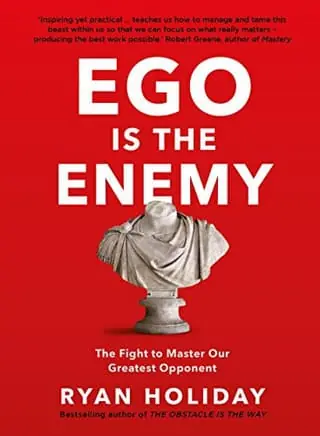
Ego Is the Enemy summary
by Ryan Holiday · 2016 · 7 key ideas · 19-minute read
An inflated sense of our own importance quietly sabotages us at every stage of life: when we're starting out, when we succeed, and when we fail.
Why read it
For ambitious people who want to keep growing without becoming arrogant, and for anyone recovering from a failure who wants to learn from it instead of being defined by it.
Ego Is the Enemy in brief
Holiday defines ego not as confidence or self-esteem but as an unhealthy belief in our own importance: arrogance, self-centred ambition, the need to be better than others and to be recognised for it. He argues that this ego is the enemy of what we want to achieve, and of the people we want to become.
The book follows a simple arc in three parts. When we aspire, ego makes us talk instead of work, crave status instead of skill, and stop learning too early. When we succeed, ego makes us complacent, entitled and controlling, and it blinds us to what actually matters. When we fail, ego makes us deny, blame and give up, instead of using the setback to grow.
Against ego, Holiday sets a cluster of quieter virtues: humility, discipline, purpose, the habit of being a student, and the ability to measure yourself by your own standards. He illustrates each with short historical portraits of generals, athletes, writers and business figures, some who mastered their egos and some who were ruined by them.
The book's tone is that of a candid mentor. Holiday admits he wrote it partly from his own experience of early success and the mistakes that came with it. The central message is that ego is never defeated once and for all; it has to be managed at every stage, with daily practices rather than a single insight.
The 7 key ideas
1. Ego shows up at every stage
Ego isn't a stage. It's a passenger on every stage.
2. Talk less, do more
Say less. Ship more.
3. To be or to do
Be somebody or do something. Choose on purpose.
4. Always be a student
Plus, minus, equal: learn up, teach down, spar across.
5. Clear the path for others
Clear someone else's path, and you'll learn the road.
6. Know what matters to you
Run your race. Ignore the other lanes.
7. Use alive time, not dead time
You can't choose the waiting room. You can choose what you do in it.
Read the full guide in Kinquire. Every idea with a real example, a diagram and one thing to try today, plus a quick quiz so it sticks. Free to start.
Read Ego Is the EnemyKey takeaways
- Notice which stage you're in and how ego might be tripping you there.
- Talk less about your plans and put the time into the work.
- Ask whether a choice is about being somebody or doing something.
- Keep a plus, a minus and an equal in your learning life.
- Help someone you admire succeed, without seeking credit.
- Turn waiting periods into alive time for building skills.
Our take
Ego Is the Enemy offers a useful mirror for ambitious people and a sensible set of habits: work quietly, keep learning, help others, stay clear on your purpose and learn from failure. Its short story-based chapters make it easy to digest. The weaknesses are similar to Holiday's other books. The historical portraits are selected to fit the thesis and can oversimplify complex figures. Some readers find the argument repetitive, and the definition of ego is broad enough to cover almost any flaw. The book also speaks mostly to the overconfident; for people struggling with low self-worth, a message about humility may land differently. Still, as a practical antidote to self-importance, it holds up.
About Ryan Holiday
Ryan Holiday is an American writer and former marketer known for popularising Stoic philosophy in books such as The Obstacle Is the Way and through The Daily Stoic.
If you liked this
- The Obstacle Is the Way by Ryan Holiday
- Meditations by Marcus Aurelius
- Mastery by Robert Greene
- Letters from a Stoic by Seneca
- The Enchiridion by Epictetus
- The Art of War by Sun Tzu