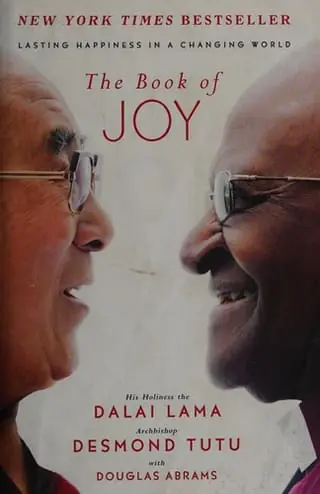
The Book of Joy summary
by Dalai Lama, Desmond Tutu and Douglas Abrams · 2016 · 8 key ideas · 20-minute read
Two spiritual leaders who endured exile and oppression explain how lasting joy comes not from easy circumstances but from qualities of mind and heart anyone can cultivate.
Why read it
For anyone who wants joy that survives hard times, told through the warm, funny friendship of two of the most admired moral figures of their era.
The Book of Joy in brief
In April 2015, Archbishop Desmond Tutu travelled to Dharamsala in India to celebrate the Dalai Lama's eightieth birthday. For a week the two friends talked about one question: how can we find joy in the face of life's inevitable suffering? Douglas Abrams recorded and moderated their conversations and wrote the book, weaving in research and his own observations.
Both men had good reason to be bitter. The Dalai Lama had lived in exile since 1959; Tutu had fought apartheid and was then living with prostate cancer. Yet both were notably joyful, always teasing and laughing. They argue that joy is not the absence of suffering but a way of meeting it.
The first part examines the nature of joy and the obstacles to it: fear, stress, anger, sadness, despair, loneliness, envy, illness and the fear of death. They agree that much of our suffering comes from how we respond to events, and that excessive self-focus amplifies it.
The heart of the book describes eight pillars of joy. Four are qualities of the mind: perspective, humility, humor and acceptance. Four are qualities of the heart: forgiveness, gratitude, compassion and generosity. Together, they form a foundation that can hold steady through hard times.
The book ends with simple joy practices drawn from both traditions — from setting a morning intention to compassion meditations. Its final message is that joy grows when we turn toward others, because, as both men insist from their different faiths, human beings are deeply interconnected.
The 8 key ideas
1. Joy is bigger than happiness
Joy isn't the absence of pain; it's a bigger heart.
2. Suffering can embitter or ennoble
Pain hardens or deepens — you get a vote.
3. Less 'me', more joy
A person is a person through other people.
4. Widen your perspective
Step back until the problem fits the frame.
5. Humility and humour
Take your purpose seriously, yourself lightly.
6. Acceptance is where change starts
Accept what is; then change what you can.
7. Forgiveness frees you
Forgive to free yourself, not to excuse them.
8. Gratitude, compassion, generosity
Count gifts, share them, cheer others' wins.
Read the full guide in Kinquire. Every idea with a real example, a diagram and one thing to try today, plus a quick quiz so it sticks. Free to start.
Read The Book of JoyKey takeaways
- Look for joy that can coexist with difficulty, not just happy moments.
- When stuck in your own problems, do something for someone else.
- Step back and ask how a setback will look in five years.
- Laugh at your own mistakes, especially in front of others.
- Accept what is before deciding what to change.
- Practise gratitude, generosity and celebrating others' success daily.
Our take
The Book of Joy is moving largely because of who is speaking: two people who suffered deeply and remained warm, playful and forgiving. Their friendship across faiths is itself a lesson. The eight pillars provide a clear, memorable structure, and much of the advice matches positive-psychology research. Its limits: because the conversations are edited and framed by Abrams, the book sometimes reads like his synthesis more than their dialogue. It can feel repetitive and occasionally sentimental. Some readers note that it says little about structural causes of suffering, and that the research cited is presented more confidently than later evidence supports.
About Dalai Lama, Desmond Tutu and Douglas Abrams
Tenzin Gyatso, the 14th Dalai Lama, and Archbishop Desmond Tutu (1931–2021) of South Africa were both Nobel Peace Prize laureates (1989 and 1984). Douglas Abrams is an American author and editor who organised and narrated their conversations.
If you liked this
- The Art of Happiness by Dalai Lama and Howard C. Cutler
- Man's Search for Meaning by Viktor E. Frankl
- Meditations by Marcus Aurelius
- Letters from a Stoic by Seneca
- The Enchiridion by Epictetus
- The Obstacle Is the Way by Ryan Holiday