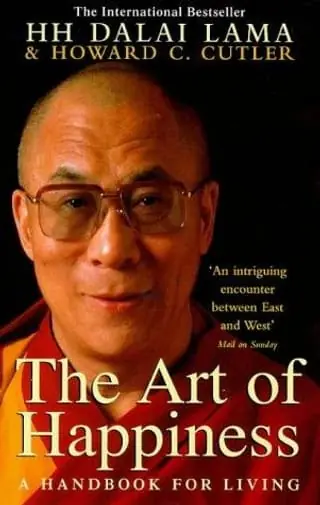
The Art of Happiness summary
by Dalai Lama and Howard C. Cutler · 1998 · 7 key ideas · 19-minute read
Happiness depends more on the state of our mind than on circumstances, and the mind can be trained — through learning, compassion and patience — toward lasting contentment.
Why read it
For anyone who wants a practical, non-dogmatic look at happiness from the Dalai Lama, filtered through the questions of a sceptical Western psychiatrist.
The Art of Happiness in brief
The book is a conversation. Cutler, a Western psychiatrist, spent extended time interviewing the Dalai Lama, including during a series of public talks in Arizona. He reports the Dalai Lama's answers, adds his own reflections and sometimes connects them to Western psychology. The tone is warm, practical and largely free of religious doctrine.
The starting claim is simple: the purpose of life is to seek happiness. The Dalai Lama argues that lasting happiness depends less on external events than on our state of mind. Because the mind can be changed, happiness can be cultivated — much like a skill — through a gradual, systematic training.
Central to that training is warmth toward others. The Dalai Lama sees compassion not as a soft extra but as the most reliable source of happiness, both for the giver and the receiver. He suggests approaching every person on the basis of what we share as human beings.
The book then turns to suffering. Some suffering is unavoidable; much of it we create ourselves, by clinging, comparing and replaying grievances. Shifting perspective — seeing a situation from a wider angle — can transform how much we suffer. Suffering, in other words, is partly a matter of how we hold it.
Finally, it tackles obstacles such as anger, hatred and anxiety. Their antidotes are patience, tolerance and sincere motivation. The closing message is that basic spiritual values — kindness, compassion, honesty — are available to everyone, religious or not. Happiness, on this view, is a skill open to anyone.
The 7 key ideas
1. The purpose of life is happiness
Want happiness? Then study it seriously.
2. Mind over circumstances
Same event, different mind, different day.
3. Training the mind
Learn, commit, act, repeat.
4. Pleasure vs happiness
Want what you have, not just have what you want.
5. Compassion is the source
Start every meeting from what you share.
6. Shift your perspective
Widen the frame, shrink the pain.
7. Patience is the antidote to anger
Patience is strength, not surrender.
Read the full guide in Kinquire. Every idea with a real example, a diagram and one thing to try today, plus a quick quiz so it sticks. Free to start.
Read The Art of HappinessKey takeaways
- Treat happiness as a skill and pick one mental habit to train this month.
- Before an indulgence, ask: 'Will this bring me happiness?'
- Practise wanting and appreciating what you already have.
- Begin each interaction by recalling what you share with the other person.
- When you feel 'Why me?', look at the situation from at least three angles.
- Respond to anger by remembering its costs and choosing patience.
Our take
The Art of Happiness brought the Dalai Lama's practical wisdom to millions in clear, accessible language, and its core ideas — training the mind, compassion, reframing — have strong parallels in positive psychology and cognitive therapy. Cutler's sceptical questions keep it grounded. Its limits: the format is sometimes repetitive, and Cutler's framing sometimes makes Buddhist ideas sound simpler than they are. The emphasis on mind over circumstances can underplay real social and economic causes of unhappiness. And because Cutler paraphrases and arranges the conversations, readers get his interpretation of the Dalai Lama as much as the Dalai Lama himself.
About Dalai Lama and Howard C. Cutler
Tenzin Gyatso, the 14th Dalai Lama, is the spiritual leader of Tibetan Buddhism and received the Nobel Peace Prize in 1989. Howard C. Cutler is an American psychiatrist who built this book from his conversations with him.
If you liked this
- The Book of Joy by Dalai Lama, Desmond Tutu and Douglas Abrams
- The Happiness Hypothesis by Jonathan Haidt
- Man's Search for Meaning by Viktor E. Frankl
- Radical Acceptance by Tara Brach
- Meditations by Marcus Aurelius
- Letters from a Stoic by Seneca