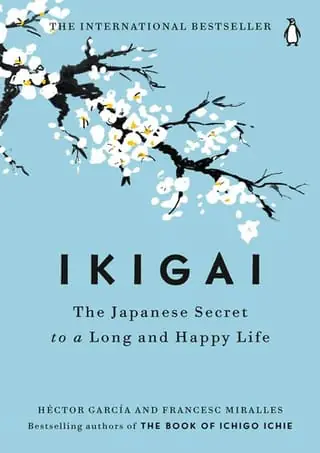
Ikigai summary
by Héctor García and Francesc Miralles · 2016 · 7 key ideas · 17-minute read
Drawing on interviews in an Okinawan village famous for long lives, the authors argue that having a reason to get up in the morning — your ikigai — plus friends, gentle activity and moderate eating keeps people well and engaged into old age.
Why read it
For anyone looking for a gentle, practical guide to purpose and healthy ageing, with simple habits you can adopt at any age.
Ikigai in brief
The authors start from a Japanese word, ikigai, which they translate as 'a reason for being' or the reason you get up in the morning. They argue that everyone has an ikigai, though many haven't found it yet, and that having one is closely linked to a long, satisfying life.
To explore this, they visited Ogimi, a rural village in northern Okinawa known for its many very old residents, and interviewed elders about their lives. They describe people who keep working in their gardens into their nineties, belong to close social groups, eat simply and stay cheerful.
The book weaves these observations with ideas from psychology and philosophy: Viktor Frankl's logotherapy and Japan's Morita therapy on finding purpose; Mihaly Csikszentmihalyi's research on flow; and Stoic and Buddhist ideas on resilience. It also includes simple advice on diet and gentle exercises such as radio taiso, tai chi and qigong.
Its themes are consistent: stay active and never fully retire from what you love, find flow in daily tasks, keep strong friendships, eat moderately, move gently, live in the present and accept imperfection. None of these habits is exotic; the point is to practise them consistently, for life.
The book ends with ten rules of ikigai, a short checklist that sums up its message: stay active, take it slow, don't fill your stomach, surround yourself with good friends, get in shape, smile, reconnect with nature, give thanks, live in the moment, and follow your ikigai.
The 7 key ideas
1. A reason to get up
Find a reason for the morning.
2. Never fully retire
Retire from a job, never from purpose.
3. Find flow
Absorbed now, fulfilled later.
4. Hara hachi bu
Leave a little room — every meal.
5. Your moai
Friends are a long-life habit.
6. Move gently, every day
Move a little, all day, every day.
7. Resilience and imperfection
Feel what you feel; do what needs doing.
Read the full guide in Kinquire. Every idea with a real example, a diagram and one thing to try today, plus a quick quiz so it sticks. Free to start.
Read IkigaiKey takeaways
- List what you love, what you're good at, and small daily joys — your ikigai is in there.
- Plan to keep a purposeful activity going for life, whatever your job does.
- Create a weekly block of distraction-free work on something challenging.
- Stop eating at about 80% full.
- Start or join a regular group of friends who look out for each other.
- Move gently every day rather than relying on occasional workouts.
Our take
Ikigai is warm, simple and easy to act on: its advice to stay active, keep friends, eat moderately and find absorbing work aligns with solid research on wellbeing and healthy ageing. Its weaknesses are depth and accuracy. The interviews are brief and anecdotal, and the book stitches together many borrowed ideas (Frankl, flow, Stoicism, Taleb) without developing them. The famous Venn diagram isn't a traditional Japanese idea, and claims such as Japanese having no word for retirement are oversimplified. Okinawa's longevity story is also more complicated than presented. Read it as gentle inspiration rather than an authoritative account of Japanese culture or the science of ageing.
About Héctor García and Francesc Miralles
Héctor García is a Spanish engineer and writer who has lived in Japan for many years; Francesc Miralles is a Spanish author based in Barcelona. Ikigai became an international bestseller translated into dozens of languages.
If you liked this
- Man's Search for Meaning by Viktor E. Frankl
- Flow by Mihaly Csikszentmihalyi
- Meditations by Marcus Aurelius
- Letters from a Stoic by Seneca
- The Enchiridion by Epictetus
- The Obstacle Is the Way by Ryan Holiday