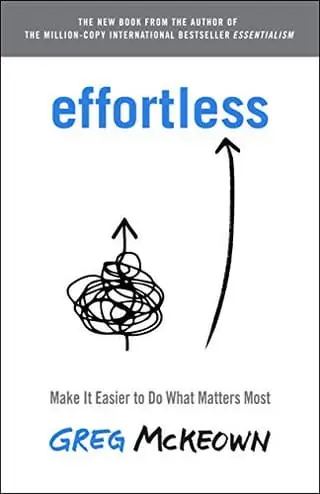
Effortless summary
by Greg McKeown · 2021 · 7 key ideas · 16-minute read
Once you know what's essential, stop forcing it: make the important things easier through a rested mind, simpler actions and systems that keep producing results.
Why read it
For people who've learned to prioritise but are still exhausted by pushing through. It's a gentle, practical guide to doing what matters without burning out.
Effortless in brief
McKeown's Essentialism taught readers to focus on the few things that matter. Effortless tackles the next problem: even when you know what's essential, doing it can feel exhausting. Our culture tells us that hard work must feel hard, and that effort is a virtue in itself. McKeown argues that this leads to burnout, and that there is often an easier way.
The book has three parts. Effortless State is about your mind and body: when you're rested, focused and not weighed down by old resentments, everything else becomes easier. He suggests inverting hard problems, pairing essential tasks with enjoyment, letting go of emotional baggage, resting properly and paying attention to the present.
Effortless Action is about doing the work: define clearly what done looks like, take the first obvious step, simplify the process, accept making messy progress, and keep a steady pace with upper and lower limits rather than bursts of overwork.
Effortless Results is about leverage: learn principles that apply again and again, teach others, automate routine tasks with checklists, build trust in teams, and prevent problems before they arise. The aim is results that keep flowing long after the effort is spent.
The 7 key ideas
1. What if this could be easy?
Hard isn't a virtue. Essential is.
2. Release and rest
Put down what you don't need to carry.
3. Define what done looks like
No finish line, no finish.
4. Start with zero steps
Start from nothing; add only what earns its place.
5. Set a steady pace
Slow is smooth. Smooth is fast.
6. Seek residual results
Do it once in a way that keeps working.
7. Prevent the problem
The best fire is the one you never fight.
Read the full guide in Kinquire. Every idea with a real example, a diagram and one thing to try today, plus a quick quiz so it sticks. Free to start.
Read EffortlessKey takeaways
- When something feels hard, ask what would make it easy, or fun.
- Define what done looks like and take the first obvious action.
- Simplify processes by starting from zero steps.
- Set a daily minimum and maximum effort for important goals.
- Invest in guides, automations and teaching that produce residual results.
Our take
Effortless is a warm, useful sequel that addresses a real gap: knowing what matters isn't the same as doing it sustainably. Ideas like defining done, upper and lower bounds and residual results are simple and powerful. But the book is lighter than Essentialism, and many chapters repackage familiar ideas from other authors, from checklists to minimum viable products. Its 'make it easy' message can sound naive for genuinely hard work like caregiving or recovery. As an antidote to glorified struggle, though, it's a welcome companion.
About Greg McKeown
Greg McKeown is a British-born author and speaker based in the United States. His earlier book Essentialism was a bestseller about doing less but better.
If you liked this
- Essentialism by Greg McKeown
- Atomic Habits by James Clear
- The Power of Habit by Charles Duhigg
- The 7 Habits of Highly Effective People by Stephen R. Covey
- Mindset by Carol S. Dweck
- Grit by Angela Duckworth