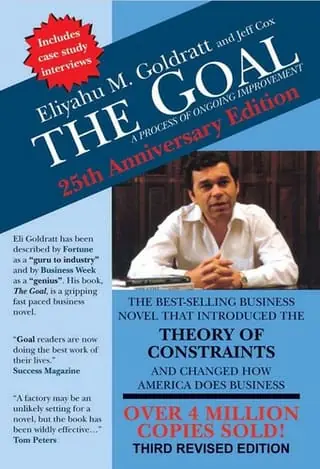
The Goal summary
by Eliyahu M. Goldratt · 1984 · 7 key ideas · 18-minute read
A business novel showing that every system’s output is limited by its bottleneck, so real improvement means finding that constraint and organizing everything around it.
Why read it
For anyone who manages work flowing through steps — a factory, a software team, a kitchen, even your own week. It is a gripping story that permanently changes how you see busyness, efficiency and progress.
The Goal in brief
Alex Rogo runs a struggling manufacturing plant. Orders are late, costs are high, and head office gives him three months to turn things around or the plant will be closed. His marriage is also fraying under the strain. By chance he reconnects with Jonah, a physicist he knew from his student days, who answers Alex’s questions mostly with more questions.
Jonah’s first challenge is to define the goal of the company. Alex realises it is to make money, now and in the future — and that many of the plant’s cherished measures, like keeping every machine and worker busy, don’t serve that goal at all. Jonah offers three simpler measures: throughput, inventory and operational expense.
Through a scout hike with his son and a game with matchsticks and dice, Alex discovers how dependent steps and normal variation create queues, and that the slowest step — the bottleneck — sets the pace for everything. His team finds the plant’s bottlenecks, protects them, feeds them wisely and lets other machines sit idle when needed.
The plant recovers. But as one constraint is broken, another appears, and Alex and his team distil what they learned into a repeatable process of ongoing improvement: identify the constraint, exploit it, subordinate everything else to it, elevate it, and start again without letting inertia set in.
The 7 key ideas
1. Know the goal and measure it
Busy isn’t the goal. Making money is.
2. Dependent events plus fluctuations
Variation travels downstream and piles up.
3. The bottleneck sets the pace
Protect the bottleneck like it’s the whole business — because it is.
4. Local efficiency is a trap
Idle is fine. Useless busyness is not.
5. Subordinate everything to the constraint
Start less, finish more.
6. Smaller batches, faster flow
Big batches look efficient; small batches flow.
7. The five focusing steps
Fix the constraint, then find the next one.
Read the full guide in Kinquire. Every idea with a real example, a diagram and one thing to try today, plus a quick quiz so it sticks. Free to start.
Read The GoalKey takeaways
- Judge decisions by their effect on throughput, inventory and operating expense.
- Find the single constraint in your system before trying to improve anything.
- Never let the bottleneck sit idle or work on the wrong things.
- Stop measuring local busyness; measure flow through the whole system.
- Limit work started to the pace of the constraint.
- When one constraint breaks, look for the next — and question old rules.
Our take
The Goal is one of the rare business books people actually enjoy, and its core insights about bottlenecks, local efficiency and flow have held up and spread far beyond factories. As a novel it is functional rather than literary: the characters are thin and the marriage subplot can feel tacked on. Real systems are often messier than a plant with one clear bottleneck, especially in knowledge work, where constraints shift and are hard to see. Evidence for the Theory of Constraints is mostly case-based. Still, few books change how readers see work so quickly.
About Eliyahu M. Goldratt
Eliyahu Goldratt was an Israeli physicist who became a management thinker and developed the Theory of Constraints. He wrote The Goal as a novel with co-author Jeff Cox; Goldratt died in 2011.
If you liked this
- The Toyota Way by Jeffrey K. Liker
- Good Strategy Bad Strategy by Richard Rumelt
- Good to Great by Jim Collins
- Built to Last by Jim Collins and Jerry I. Porras
- The Innovator's Dilemma by Clayton M. Christensen
- Blue Ocean Strategy by W. Chan Kim and Renée Mauborgne