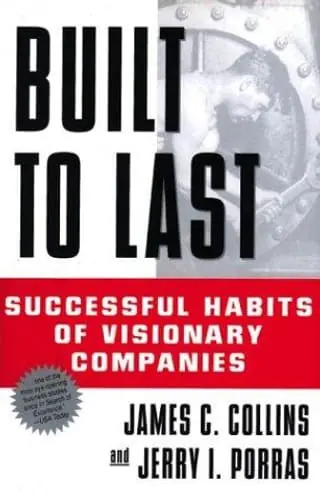
Built to Last summary
by Jim Collins and Jerry I. Porras · 1994 · 7 key ideas · 18-minute read
Enduring companies are built around a fixed core of values and purpose, while everything else — strategies, products, practices — is pushed to change and improve relentlessly.
Why read it
For founders and leaders who want to build an organization that outlives any single product or leader. It replaces the myth of the visionary genius with practical habits for building something that keeps renewing itself.
Built to Last in brief
Collins and Porras studied eighteen ‘visionary companies’ — long-lived industry leaders such as 3M, Boeing, Disney, Johnson & Johnson, Merck, Sony and Walmart — and compared each with a strong rival that had performed less well over the long run, such as Norton against 3M or Zenith against Motorola. The question was what truly distinguished the exceptional companies across many decades.
Their first finding knocks down a set of myths. Visionary companies often did not start with a great idea, were not always led by charismatic heroes, and did not exist simply to maximise profit. Their founders were architects: they focused on building an organization that could keep producing good products and leaders, rather than on one brilliant product.
At the centre of each company sat a core ideology — a small set of values and a purpose beyond making money — that stayed fixed for generations. Around that core, the companies pushed hard for progress through bold goals, constant experimentation, home-grown leaders and a refusal to be satisfied.
The book’s master idea is to preserve the core and stimulate progress, and to align every policy, incentive and practice so the organization sends one consistent message. Visionary companies refused to accept trade-offs as given: they wanted both stability and change, both purpose and profit.
The 7 key ideas
1. Build a clock, don’t tell the time
Don’t be the clock. Build it.
2. The genius of the AND
Before you choose, ask: why not both?
3. Core ideology: more than profits
Profit is oxygen, not the reason to breathe.
4. Preserve the core, stimulate progress
Hold your values tight and your methods loose.
5. Big Hairy Audacious Goals
A goal so big and clear it pulls you forward.
6. Cult-like cultures
Great for the believers, wrong for everyone else — and that’s fine.
7. Try a lot of stuff and keep what works
Plant many seeds; water the ones that sprout.
Read the full guide in Kinquire. Every idea with a real example, a diagram and one thing to try today, plus a quick quiz so it sticks. Free to start.
Read Built to LastKey takeaways
- Write down your core values and a purpose beyond profit, and keep them short.
- Separate what must never change from what is merely habit.
- Set one Big Hairy Audacious Goal that fits your core.
- Run many small experiments and keep only what works.
- Grow leaders from within who understand the culture.
- Look for ways to get both sides of a trade-off before choosing.
Our take
Built to Last offers enduring ideas — the core-versus-practices distinction and the case for purpose beyond profit remain genuinely useful. But its method shares the weaknesses of Good to Great: picking successful firms and looking back for common traits invites hindsight and the halo effect, as Phil Rosenzweig has argued. Several visionary companies, including Motorola, Ford and Sony, later went through severe struggles. The book is best read as a thoughtful framework rather than proof that these habits guarantee longevity.
About Jim Collins and Jerry I. Porras
Jim Collins and Jerry Porras did the research behind this book at Stanford’s Graduate School of Business, where Porras was a professor. Collins later wrote Good to Great.
If you liked this
- Good to Great by Jim Collins
- The Innovator's Dilemma by Clayton M. Christensen
- Blue Ocean Strategy by W. Chan Kim and Renée Mauborgne
- Good Strategy Bad Strategy by Richard Rumelt
- The Goal by Eliyahu M. Goldratt
- Measure What Matters by John Doerr