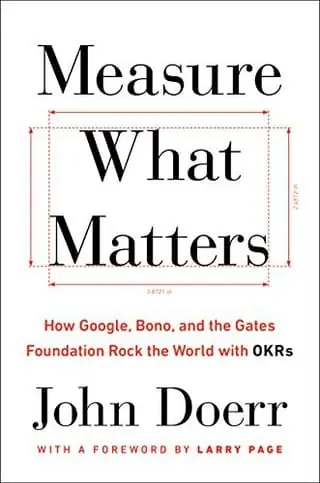
Measure What Matters summary
by John Doerr · 2018 · 7 key ideas · 18-minute read
Objectives and key results (OKRs) — a few ambitious goals, each with measurable results — help organizations focus, align, track progress and stretch further than they thought possible.
Why read it
For managers, founders and team leads who want a simple, proven way to set goals and keep everyone pulling in the same direction. It is also the most popular introduction to the OKR method used at Intel and Google.
Measure What Matters in brief
Doerr learned a goal-setting system at Intel from its legendary leader Andy Grove, who had adapted Peter Drucker’s management by objectives. Grove’s version paired each objective — what you want to achieve — with a few key results that show, measurably, whether you got there. Years later, as a venture capitalist, Doerr introduced the system to a young Google, which still uses it.
The book argues that OKRs give organizations four ‘superpowers’: focus and commitment to priorities, alignment and connection across teams, tracking for accountability, and stretching for ambitious outcomes. Each is illustrated with stories from companies and organizations Doerr has worked with, often told by the people involved.
In the second half, Doerr adds a companion practice he calls CFRs — conversations, feedback and recognition — to replace or supplement the traditional annual performance review. OKRs set the direction; CFRs keep people engaged and improving along the way.
The underlying message is that ideas are easy and execution is everything. Writing down a small number of clear, measurable goals, sharing them openly and reviewing them regularly is a simple discipline that, Doerr argues, can transform how an organization performs.
The 7 key ideas
1. Objectives and key results
Objective is the destination; key results are the mile markers.
2. Focus and commit
Few goals, fully committed.
3. Align and connect
Make goals visible so people can connect.
4. Track for accountability
A goal you don’t review is just a wish.
5. Stretch for amazing
Aim for the moon; 70% still gets you far.
6. Continuous conversations, not annual reviews
Feedback is a habit, not an annual event.
7. Measure outcomes — and pair them
Every number needs a buddy.
Read the full guide in Kinquire. Every idea with a real example, a diagram and one thing to try today, plus a quick quiz so it sticks. Free to start.
Read Measure What MattersKey takeaways
- Set no more than three objectives per quarter, each with measurable key results.
- Write key results as outcomes, not activities, and pair quantity with quality.
- Make goals visible and let teams propose their own.
- Check in weekly and adjust OKRs openly when things change.
- Separate stretch goals from pay so people dare to aim high.
- Replace annual reviews with regular conversations, feedback and recognition.
Our take
Measure What Matters is a clear and energising introduction to OKRs, and the method’s basic disciplines — few goals, measurable results, transparency and regular review — are sound. But the book leans heavily on success stories, many from companies Doerr invested in or advised, and offers little evidence about where OKRs failed. In practice many organizations find OKRs turn bureaucratic or become a substitute for real strategy, as critics like Richard Rumelt would warn. Treat OKRs as a tool for executing a strategy, not as the strategy itself.
About John Doerr
John Doerr is a venture capitalist at Kleiner Perkins who was an early investor in companies including Google and Amazon. He began his career as an engineer and salesperson at Intel in the 1970s.
If you liked this
- High Output Management by Andrew S. Grove
- Good Strategy Bad Strategy by Richard Rumelt
- Radical Candor by Kim Scott
- Good to Great by Jim Collins
- Built to Last by Jim Collins and Jerry I. Porras
- The Innovator's Dilemma by Clayton M. Christensen