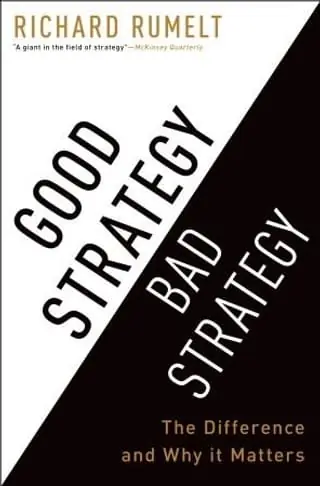
Good Strategy Bad Strategy summary
by Richard Rumelt · 2011 · 7 key ideas · 18-minute read
Most so-called strategies are just goals and slogans; real strategy diagnoses the challenge, chooses a guiding approach, and concentrates coherent action where it will have the most effect.
Why read it
For anyone who has sat through a ‘strategy’ presentation full of ambition and empty of choices. It gives you a sharp test for telling real strategy from fluff — at work, in a project or in your own life.
Good Strategy Bad Strategy in brief
Rumelt’s starting point is that much of what organizations call strategy is bad strategy. It is not merely the absence of good strategy; it is a recognisable pattern of fluff, failure to face the real problem, goals dressed up as plans, and wish lists of objectives. It flourishes because choosing is painful and because templates make it easy to produce documents that sound strategic.
Good strategy, by contrast, has a simple underlying structure he calls the kernel: a diagnosis that explains what is going on, a guiding policy for dealing with it, and a set of coherent actions that carry it out. It is often surprising, because so few organizations actually do it.
Rumelt then explores sources of power that good strategy draws on: leverage, proximate objectives, chain-link systems, design, focus and advantage, as well as understanding dynamics, inertia and entropy. His examples range from Nelson at Trafalgar to Steve Jobs’s rescue of Apple.
He ends with how to think like a strategist: treat strategy as a hypothesis to be tested rather than a forecast to defend, question your own first ideas instead of falling in love with them, and keep an independent judgement when colleagues, markets and analysts all share the same comfortable story.
The 7 key ideas
1. The four marks of bad strategy
A goal is not a strategy. A slogan even less.
2. The kernel of good strategy
Diagnose, decide the approach, then act in concert.
3. Strategy means choosing
If nothing is cut, nothing was chosen.
4. Leverage: concentrate on the pivot point
Find the pivot. Push there, hard.
5. Proximate objectives
Aim for the next foothold, not just the summit.
6. Chain-link systems
A chain is only as strong as its worst link.
7. Strategy is a hypothesis
Bet with reasons, then let reality grade you.
Read the full guide in Kinquire. Every idea with a real example, a diagram and one thing to try today, plus a quick quiz so it sticks. Free to start.
Read Good Strategy Bad StrategyKey takeaways
- Test any plan for a diagnosis, a guiding policy and coherent actions.
- Strip out buzzwords and targets to see if real choices remain.
- Concentrate resources on the pivotal point rather than spreading them.
- Set proximate objectives that people can actually achieve.
- Fix the weakest link before polishing the strongest.
- Treat your strategy as a hypothesis and decide in advance what would prove it wrong.
Our take
Rumelt writes with unusual clarity, and his kernel and his description of bad strategy are among the most practical tools in the field — many readers find their own organization’s plan described uncomfortably well. The book is less of a step-by-step method: chapters on sources of power can feel like a loosely linked collection, and the examples are often retrospective. It also says little about how to get a reluctant organization to accept hard choices. Still, it has aged well and remains a standard recommendation for managers and strategists.
About Richard Rumelt
Richard Rumelt is a professor emeritus at UCLA’s Anderson School of Management and a long-time strategy adviser to companies and government. He later wrote The Crux (2022).
If you liked this
- Playing to Win by A.G. Lafley and Roger L. Martin
- Competitive Strategy by Michael E. Porter
- The Goal by Eliyahu M. Goldratt
- Good to Great by Jim Collins
- Built to Last by Jim Collins and Jerry I. Porras
- The Innovator's Dilemma by Clayton M. Christensen