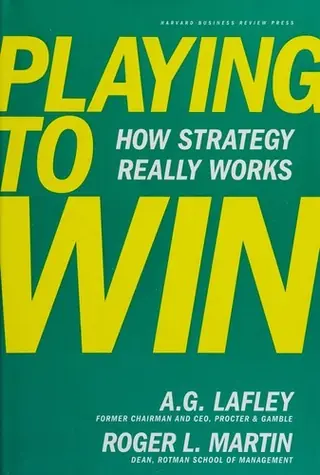
Playing to Win summary
by A.G. Lafley and Roger L. Martin · 2013 · 7 key ideas · 19-minute read
Strategy is a small set of integrated choices — what winning means, where to play, how to win, what capabilities you need and what systems support them — that together position you to win.
Why read it
For managers at any level who are asked to ‘write a strategy’ and want a practical, repeatable method. It turns strategy from a long document into five linked questions anyone can answer.
Playing to Win in brief
Lafley and Martin worked together for years at Procter & Gamble, where Lafley led a turnaround and expansion of the company. This book distils the approach they used. Its central claim is that strategy is about winning, and that winning requires making explicit, coordinated choices rather than writing visions, plans or lists of initiatives.
They frame strategy as a cascade of five questions. What is our winning aspiration? Where will we play? How will we win there? What capabilities must be in place? And what management systems are required? Each answer constrains the next, and all five must fit together.
The book illustrates the cascade with P&G cases, from the reinvention of Olay to the company’s decisions about which categories and markets to pursue. It also offers tools: a strategy logic flow for analysing industries and customers, and a method built around one question — what would have to be true for this option to be a great choice?
Throughout, the authors warn against common traps: trying to do everything, attacking the strongest competitor head-on, offering something for everyone, or confusing aspirations with strategy. Strategy, they insist, means choosing — and choosing means saying no to options that are attractive but don’t fit.
The 7 key ideas
1. Strategy is choosing to win
Play to win, not just to play.
2. The five-question cascade
Five questions, one coherent answer.
3. Define what winning means
If you can’t win there, don’t play there.
4. Choose where to play
Where you won’t play defines where you will.
5. Decide how to win
Be cheaper or be different — clearly.
6. Capabilities and systems
Capabilities win; systems keep them winning.
7. Ask what would have to be true
Don’t argue — test what must be true.
Read the full guide in Kinquire. Every idea with a real example, a diagram and one thing to try today, plus a quick quiz so it sticks. Free to start.
Read Playing to WinKey takeaways
- Write your strategy as five linked choices, not a list of goals.
- Define winning — and avoid markets where you can’t win.
- State explicitly where you will not play.
- Choose cost leadership or a clear differentiation, and make it specific.
- Build reinforcing capabilities and systems that protect them.
- Settle strategy debates by testing what would have to be true.
Our take
Playing to Win offers one of the clearest practical frameworks for strategy, and the five-question cascade is widely used in companies and classrooms. Its examples, however, come overwhelmingly from P&G, a large consumer-goods company with vast resources, and the authors were insiders telling a success story. The framework is better at structuring choices than at generating creative ones, and it says relatively little about fast-moving tech markets. Still, its insistence that strategy means choosing remains as useful as ever.
About A.G. Lafley and Roger L. Martin
A.G. Lafley was chief executive of Procter & Gamble from 2000 to 2010, and returned to the role from 2013 to 2015. Roger Martin was dean of the Rotman School of Management at the University of Toronto and worked closely with Lafley as an adviser.
If you liked this
- Good Strategy Bad Strategy by Richard Rumelt
- Competitive Strategy by Michael E. Porter
- 7 Powers by Hamilton Helmer
- Good to Great by Jim Collins
- Built to Last by Jim Collins and Jerry I. Porras
- The Innovator's Dilemma by Clayton M. Christensen