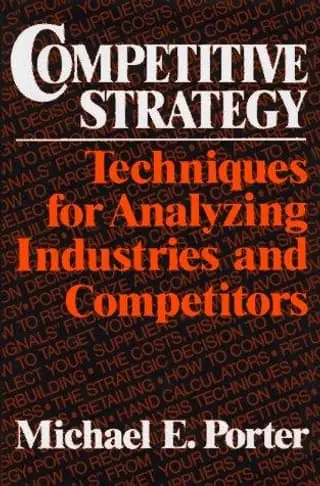
Competitive Strategy summary
by Michael E. Porter · 1980 · 7 key ideas · 17-minute read
An industry’s profitability is shaped by five competitive forces, and a company earns above-average returns by positioning itself against them through cost leadership, differentiation or focus.
Why read it
For anyone who wants to understand why some industries are far more profitable than others, and how to choose a defensible position. It is the foundation of modern strategy and still the starting point for most industry analysis.
Competitive Strategy in brief
Porter set out to give managers a rigorous way to analyse competition, drawing on industrial economics. His core argument is that the intensity of competition in an industry is not a matter of luck or management quality alone; it is rooted in the industry’s underlying structure, which he describes as five competitive forces.
Those forces are the threat of new entrants, the bargaining power of buyers, the bargaining power of suppliers, the threat of substitute products, and rivalry among existing competitors. Together they determine how much of the value an industry creates its companies can keep as profit.
Against these forces, Porter describes three generic strategies for outperforming rivals: overall cost leadership, differentiation and focus. Each demands different resources, skills and organisation, and a firm that fails to commit clearly to one of them risks being ‘stuck in the middle’, with poor profitability.
The rest of the book provides tools for applying this thinking: analysing competitors’ goals and likely moves, reading market signals, understanding strategic groups within an industry, and adapting strategy to different industry environments — fragmented, emerging, mature, declining and global.
The 7 key ideas
1. Five forces shape profitability
Your competition is bigger than your competitors.
2. Barriers to entry
Profits attract rivals unless the walls are high.
3. Who has the bargaining power?
Whoever needs the other less takes the profit.
4. Three generic strategies
Cheapest, most distinctive, or best for a few — pick one.
5. Don’t get stuck in the middle
Be something to someone, not everything to everyone.
6. Analyse your competitors
Know what your rival wants, believes and can do.
7. Strategy depends on the industry’s stage
The right move depends on the industry’s season.
Read the full guide in Kinquire. Every idea with a real example, a diagram and one thing to try today, plus a quick quiz so it sticks. Free to start.
Read Competitive StrategyKey takeaways
- Map the five forces before judging an industry’s attractiveness.
- Identify and strengthen the barriers that protect your position.
- Reduce dependence on any single powerful buyer or supplier.
- Choose clearly between cost leadership, differentiation and focus.
- Build a profile of each major competitor’s goals and likely response.
- Adapt your strategy to the stage your industry is in.
Our take
Competitive Strategy transformed the field and remains the backbone of industry analysis; the five forces and generic strategies are still taught everywhere. Its limits are now clear. The framework is relatively static, written for industries with stable boundaries, and less suited to fast-changing technology markets, platforms and ecosystems where cooperation matters as much as competition. Research suggests company-specific factors explain more profit differences than industry alone. And its claim that cost and differentiation can’t be combined has been challenged. Use it as a disciplined starting point, not a complete theory.
About Michael E. Porter
Michael Porter is a professor at Harvard Business School and one of the most influential scholars of business strategy. He followed this book with Competitive Advantage (1985).
If you liked this
- Blue Ocean Strategy by W. Chan Kim and Renée Mauborgne
- 7 Powers by Hamilton Helmer
- Playing to Win by A.G. Lafley and Roger L. Martin
- Good to Great by Jim Collins
- Built to Last by Jim Collins and Jerry I. Porras
- The Innovator's Dilemma by Clayton M. Christensen