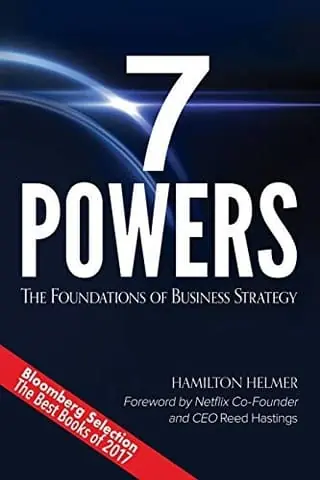
7 Powers summary
by Hamilton Helmer · 2016 · 8 key ideas · 21-minute read
A business earns lasting above-average profits only if it has Power — a real benefit combined with a barrier rivals can’t cross — and there are just seven types of it.
Why read it
For founders, investors and strategists who want a rigorous, compact way to judge whether a business can stay valuable. It turns the vague idea of a ‘moat’ into a precise checklist.
7 Powers in brief
Helmer defines strategy narrowly and precisely: a route to continuing Power in significant markets. Power is the set of conditions that let a company earn persistently higher returns than its competitors. Without it, competition eventually drives profits down to normal levels, however good the product.
Every type of Power needs two ingredients: a benefit that improves cash flow, through higher prices or lower costs, and a barrier that stops competitors from copying it and competing the benefit away. Helmer argues that there are exactly seven forms this can take: scale economies, network economies, counter-positioning, switching costs, branding, cornered resource and process power.
Each chapter explains one Power through a case, including Netflix, Vanguard, Pixar and Toyota. For each, Helmer sets out what the benefit is, what the barrier is, and how a strategist can recognise the Power or deliberately set out to build it — along with the conditions under which it weakens.
The book closes with timing. Different Powers become available at different stages of a business’s life — at origination, during takeoff and in stability — so the strategist’s job is to recognise which Powers are open now and invest in establishing them before the window closes.
The 8 key ideas
1. Power is benefit plus barrier
No barrier, no Power — just a head start.
2. Scale and network economies
Bigger can mean cheaper — or more valuable.
3. Counter-positioning
Win where copying you hurts them.
4. Switching costs
Hard to leave means easier to keep.
5. Branding
A brand is reputation that pays a premium.
6. Cornered resource
Own what others can’t buy.
7. Process power
What took years to learn takes years to copy.
8. Timing: the Power progression
Build the Power the moment allows.
Read the full guide in Kinquire. Every idea with a real example, a diagram and one thing to try today, plus a quick quiz so it sticks. Free to start.
Read 7 PowersKey takeaways
- Test every claimed advantage for both a benefit and a barrier.
- Look for business models incumbents would hurt themselves to copy.
- In fast-growing markets, push hard for scale or network leadership.
- Treat brand and process advantages as decade-long investments.
- Be strict about ‘cornered resources’ — great people alone rarely count.
- Match your strategy to your stage: origination, takeoff or stability.
Our take
7 Powers is unusually rigorous and compact; its benefit-plus-barrier test cuts through vague talk of competitive advantage. But the book is dense, and its cases are few and largely drawn from well-known winners, so it is better at explaining success after the fact than at predicting it. Helmer’s claim that there are exactly seven Powers is a strong one; some readers argue that regulation, government licences or ecosystem control deserve separate treatment. It also says less about how to invent the product that creates Power in the first place. Still, it is one of the best modern frameworks for strategy.
About Hamilton Helmer
Hamilton Helmer is an American strategy consultant and investor. He worked as a strategy adviser to Netflix, which features prominently in the book.
If you liked this
- Competitive Strategy by Michael E. Porter
- The Innovator's Dilemma by Clayton M. Christensen
- Good Strategy Bad Strategy by Richard Rumelt
- Creativity, Inc. by Ed Catmull with Amy Wallace
- Good to Great by Jim Collins
- Built to Last by Jim Collins and Jerry I. Porras