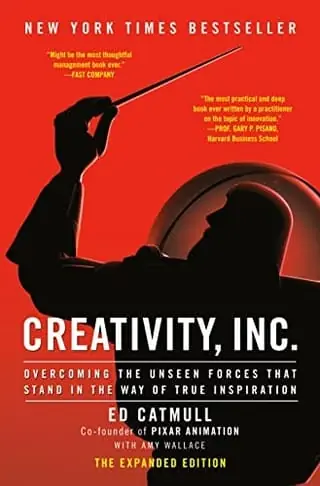
Creativity, Inc. summary
by Ed Catmull with Amy Wallace · 2014 · 7 key ideas · 18-minute read
Pixar's co-founder explains how to build a culture where creativity survives success: candid feedback, protection for fragile ideas, acceptance of failure, and leaders who hunt for hidden problems.
Why read it
For managers, founders and anyone who works in a team that needs to keep producing original work. It's a rare inside look at how a famously creative company actually runs.
Creativity, Inc. in brief
Catmull tells the story of his lifelong goal: to make the first computer-animated feature film. After years of research and a long stretch at Lucasfilm, he helped found Pixar, which, with Steve Jobs as owner, released Toy Story in 1995. Then he realised his new goal was harder: building a company that could stay creative after success.
The core of the book is the management philosophy Pixar developed. Every film starts out bad, so the culture must protect fragile early ideas and fix them through candid feedback, especially through the Braintrust, a group of experienced filmmakers who review films honestly but have no power to impose solutions.
Catmull argues that failure is a natural part of doing something new, that leaders can't see most of what goes on in their own organisations, and that good people matter more than good ideas. He describes concrete tools: daily reviews of unfinished work, research trips, limits and post-mortems.
Later chapters cover Disney's purchase of Pixar in 2006 and how Catmull and John Lasseter applied the same principles to revive Walt Disney Animation Studios. A closing chapter reflects on Steve Jobs's growth as a person and partner. The message: creativity must be managed, not left to chance, and culture is never 'finished'.
The 7 key ideas
1. All films start as ugly babies
Don't judge the baby by the adult's standards.
2. Candor and the Braintrust
Candid notes, no mandate: the creator decides.
3. Failure is the cost of new
No failures means no new ideas.
4. Look for the hidden
If you can't see a problem, look harder.
5. People over ideas
Get the people right; they'll get the idea right.
6. Show unfinished work daily
Show it ugly, fix it early.
7. Protect the culture, always
Culture isn't built once. It's kept daily.
Read the full guide in Kinquire. Every idea with a real example, a diagram and one thing to try today, plus a quick quiz so it sticks. Free to start.
Read Creativity, Inc.Key takeaways
- Protect new ideas from being judged by finished-product standards.
- Build a feedback group that gives candid notes but no orders.
- Make early, cheap failure safe and talk openly about your own mistakes.
- Actively ask people what problems you're not seeing.
- Invest in the team and its chemistry before polishing the idea.
- Show unfinished work early and run a post-mortem after each project.
Our take
Creativity, Inc. is one of the most thoughtful books on managing creative work, full of concrete practices and refreshingly honest about mistakes and uncertainty. Its tools, candid peer feedback without mandates, protecting early ideas and actively hunting for hidden problems, transfer well to other industries. Its limits are that it's an insider's account of a uniquely talented, well-funded studio, so not everything scales down, and the portrait of Pixar is generous. Events after publication, including the 2018 departure of John Lasseter following misconduct allegations, show that even a carefully tended culture can have serious blind spots, which arguably reinforces Catmull's own point about the hidden.
About Ed Catmull with Amy Wallace
Ed Catmull is a computer scientist and pioneer of computer graphics who co-founded Pixar Animation Studios and served as its president, later also leading Walt Disney Animation Studios. Amy Wallace is a journalist who co-wrote the book.
If you liked this
- Originals by Adam Grant
- Steve Jobs by Walter Isaacson
- The Ride of a Lifetime by Robert Iger
- Steal Like an Artist by Austin Kleon
- The War of Art by Steven Pressfield
- Big Magic by Elizabeth Gilbert