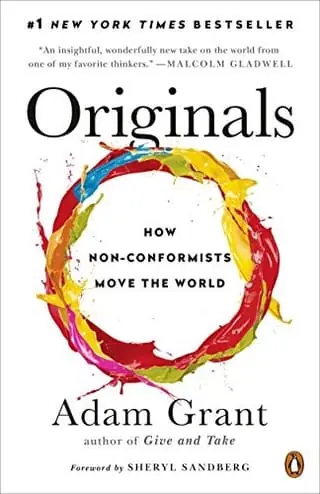
Originals summary
by Adam Grant · 2016 · 7 key ideas · 18-minute read
Original people aren't fearless risk-takers; they question defaults, generate many ideas, manage risk, time their moves and speak up in ways others can hear.
Why read it
For anyone with an idea they want to champion at work or in the world. Grant combines research and stories to show how non-conformists actually succeed, and how leaders and parents can encourage them.
Originals in brief
Grant defines originality as introducing and championing ideas that are both unusual and improve things. Most of us accept the world's defaults, but originals question them. The surprise is that originals are often not daring risk-takers; many are cautious people who balance bold bets with safe ones and who feel just as much doubt and fear as anyone else.
The early chapters explore how to generate and choose ideas. Creators are poor judges of their own work and managers are often too critical, so produce lots of ideas and seek feedback from peers in your field. Timing matters too: moderate procrastination can help creativity, and being first to market is often less advantageous than people assume.
Next, Grant looks at how to get original ideas heard: how to speak up to people in power, how to make the unfamiliar feel familiar, and how to build coalitions with people who share your methods even if they don't share all your values.
The final chapters turn to environments. Grant discusses how parents and teachers can nurture originality, how organisations can avoid groupthink by welcoming real dissent, and how individuals can manage the emotions of going against the grain, using fear and doubt as fuel rather than reasons to stop.
The 7 key ideas
1. Question the default
Look at the familiar as if seeing it for the first time.
2. Balance your risk portfolio
Be bold in one place by being safe in another.
3. Quantity leads to quality
Your first idea is rarely your most original.
4. Ask peers, not yourself
Don't trust your own crush or your boss's frown. Ask a peer.
5. Time it well
Start fast. Finish slow.
6. Pitch with the flaws first
Lead with the flaws; let them argue for it.
7. Use fear, welcome dissent
Don't calm the fear. Aim it.
Read the full guide in Kinquire. Every idea with a real example, a diagram and one thing to try today, plus a quick quiz so it sticks. Free to start.
Read OriginalsKey takeaways
- List defaults you accept and question one of them.
- Take a big risk in one area while staying stable in another.
- Generate many ideas before judging any of them.
- Ask peers in your field, not just yourself or your boss, to judge ideas.
- Start early but leave time for ideas to incubate before finishing.
- Pitch new ideas by naming their weaknesses first.
Our take
Originals is lively and full of memorable stories, and its central message, that originality is learnable and compatible with caution, is encouraging and broadly sensible. Its weakness is the style common to popular psychology: single studies and striking anecdotes carry a lot of weight, some findings are correlational, and some topics, such as birth order, rest on research that later large studies have found to have small or negligible effects on personality. Survivorship bias also lurks: we mostly hear about originals who succeeded. Read it as an inspiring set of hypotheses and practical tactics rather than settled science.
About Adam Grant
Adam Grant is an organisational psychologist and professor at the Wharton School of the University of Pennsylvania. He is also the author of Give and Take and Think Again.
If you liked this
- Creativity, Inc. by Ed Catmull with Amy Wallace
- Range by David Epstein
- Steal Like an Artist by Austin Kleon
- The War of Art by Steven Pressfield
- Big Magic by Elizabeth Gilbert
- The Artist's Way by Julia Cameron