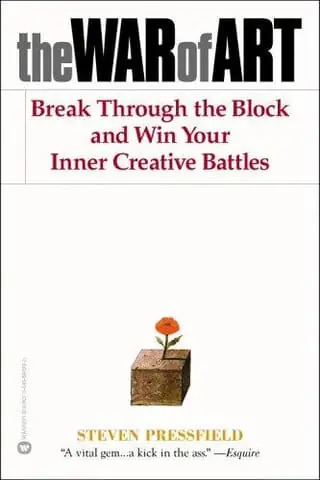
The War of Art summary
by Steven Pressfield · 2002 · 7 key ideas · 17-minute read
An invisible force called Resistance stops us doing our most important work, and the only way to beat it is to turn pro and show up every day.
Why read it
For anyone with a novel, business, practice or project they keep 'meaning to start'. It names the inner sabotage precisely and gives a blunt, workmanlike answer to it.
The War of Art in brief
Pressfield writes in short, punchy sections grouped into three parts. The first names the enemy. Most of us have two lives, he says: the one we live and the unlived one inside us. Between them stands Resistance, a universal inner force that appears whenever we try to do something that would help us grow, from writing a book to starting a diet to launching a venture.
Resistance is invisible, relentless and impersonal. It shows up as procrastination, distraction, rationalisation, self-doubt, drama and the urge to seek easy comfort. Crucially, it is strongest around the work that matters most, so the fear you feel is a compass pointing to your calling.
The second part is the cure: turning pro. Amateurs work when they feel inspired; professionals show up every day, stay all day, master their craft, accept that the work is hard and don't take rejection personally. Pressfield argues that the moment you commit to working like a professional, mysterious help begins to arrive.
The third part goes beyond Resistance into something spiritual. Pressfield describes invoking the Muse each morning, believing that ideas come from a deeper source he calls the Self. He contrasts working for status and approval with working for the work itself, and urges readers to do what they were put here to do, because the world needs their contribution.
The 7 key ideas
1. Meet Resistance
It's not you being lazy. It's Resistance, right on time.
2. Fear is a compass
The bigger the fear, the more it matters.
3. Spot Resistance's disguises
Resistance never says no. It says not yet.
4. Turn pro
Inspiration strikes at nine sharp, if you're at the desk.
5. Finish, then start the next one
Finish it. Then start the next one tomorrow.
6. Territory, not hierarchy
Last person on earth: would you still make it?
7. Invoke the Muse
Show up first. The help comes after.
Read the full guide in Kinquire. Every idea with a real example, a diagram and one thing to try today, plus a quick quiz so it sticks. Free to start.
Read The War of ArtKey takeaways
- Name your procrastination 'Resistance' so it stops feeling like a character flaw.
- Treat the project that scares you most as a sign it matters most.
- Set fixed working hours and keep them regardless of mood.
- Push past the scary last 10% and ship, then start the next thing.
- Judge your work by the doing, not by approval or rank.
- Use a short opening ritual to mark the start of each session.
Our take
The War of Art is one of the most quoted books on creative procrastination because it names the problem vividly and offers a simple, actionable answer: show up daily like a pro. Many readers find that liberating. Its weaknesses are its absolutism and mysticism. Resistance is a metaphor treated as a cosmic law, the third part relies on angels and Muses, and some sections dismiss therapy, support and self-care in ways that can feel harsh, especially for people dealing with depression or real constraints. The binary of amateur versus pro also ignores seasons of life. Use it as fuel and a framework, not as science.
About Steven Pressfield
Steven Pressfield is an American novelist and screenwriter best known for The Legend of Bagger Vance and the historical novel Gates of Fire, about the battle of Thermopylae. He worked many jobs and wrote for years before achieving success.
If you liked this
- Big Magic by Elizabeth Gilbert
- The Artist's Way by Julia Cameron
- Steal Like an Artist by Austin Kleon
- The Creative Act by Rick Rubin
- On Writing by Stephen King
- Bird by Bird by Anne Lamott