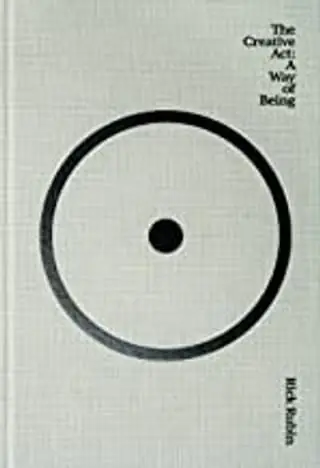
The Creative Act summary
by Rick Rubin · 2023 · 7 key ideas · 17-minute read
Creativity is a way of being, not a special talent: pay deep attention, stay open to what comes through you, and make the work for yourself.
Why read it
For anyone who makes things, or wants to, and is tired of hacks and formulas. It reads like a series of short meditations and helps you rethink how you notice, start, shape and finish work.
The Creative Act in brief
Rubin begins with a broad claim: everyone is a creator. Creativity isn't reserved for artists; any act of bringing something into being, or of truly noticing the world, is creative. The artist's job is less about producing objects than about living in a state of attention and openness.
He describes a 'Source' of ideas outside ourselves, which we tune into like an antenna. What we pick up passes through our own filter of beliefs, memories and moods, so the work shaped by that filter becomes uniquely ours. Keeping the filter clear and the vessel full means constantly taking in, noticing and staying curious.
Rubin then walks through the life of a project: gathering seeds, experimenting freely, crafting the strongest version, and completing it. Along the way he encourages questioning rules, adopting a beginner's mind, and treating self-doubt and mistakes as part of the process rather than signs of failure.
Finally, he insists that the audience comes last. Make what you love, to the highest standard you can, and only then release it. A finished work is a snapshot of who you were at that moment; letting it go frees you to keep growing into the next one.
The 7 key ideas
1. Everyone is a creator
Pay attention, and you're already creating.
2. Tune in to the Source
You're not the factory. You're the antenna.
3. The vessel and the filter
Feed the vessel widely. Clean the filter often.
4. Seeds, experiment, craft, complete
Know your phase: gather, play, build, release.
5. Question every rule
Every rule is a hypothesis. Test it.
6. The audience comes last
Make what you love. Let the audience find it.
7. Finish, release, move on
It's a snapshot, not a tombstone. Release it.
Read the full guide in Kinquire. Every idea with a real example, a diagram and one thing to try today, plus a quick quiz so it sticks. Free to start.
Read The Creative ActKey takeaways
- Note daily what you created or closely noticed to build the habit of attention.
- Take regular walks without input and capture any idea that arrives.
- Feed your vessel with great work from outside your own field.
- Name which phase a project is in and use the matching mindset.
- Break one rule of your craft on purpose.
- Make the work you love, then finish and release it.
Our take
The Creative Act is beautifully calm and reaches people who find standard creativity advice too mechanical; many artists say it changed how they approach their work. Its strengths are its emphasis on attention, openness and honest taste. Its weaknesses are vagueness and repetition: many short chapters restate similar ideas, there are few concrete examples or methods, and the metaphysics of a 'Source' is asserted rather than argued. Advice to ignore the audience suits someone with Rubin's track record better than a beginner who needs feedback. It's best read slowly, a few pages at a time, alongside more practical craft books.
About Rick Rubin
Rick Rubin is an American record producer who co-founded the hip-hop label Def Jam Recordings in the 1980s. He has produced artists across genres, including the Beastie Boys and Johnny Cash's late-career American Recordings albums.
If you liked this
- Big Magic by Elizabeth Gilbert
- The War of Art by Steven Pressfield
- Steal Like an Artist by Austin Kleon
- The Artist's Way by Julia Cameron
- On Writing by Stephen King
- Bird by Bird by Anne Lamott