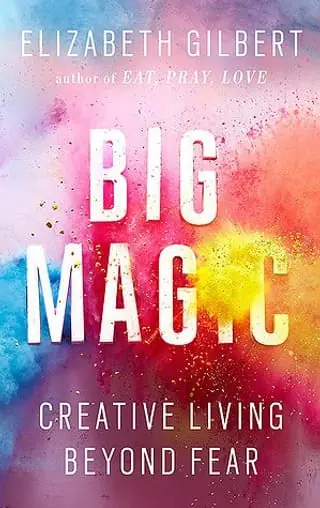
Big Magic summary
by Elizabeth Gilbert · 2015 · 7 key ideas · 17-minute read
Live a creative life driven by curiosity rather than fear: let fear ride along, treat ideas as visitors, give yourself permission, and make things for the joy of it.
Why read it
For anyone who wants more creativity in their life but feels blocked by fear, perfectionism or the belief they need credentials or a big audience. It's warm, permission-giving and full of stories.
Big Magic in brief
Gilbert defines creative living broadly: any life driven more strongly by curiosity than by fear. You don't have to be a professional artist; you just have to be willing to explore the treasures hidden inside you. The book is organised in six parts: Courage, Enchantment, Permission, Persistence, Trust and Divinity.
She starts with fear, which she treats as a normal travelling companion that will never leave but must never be allowed to drive. Then she offers a deliberately magical view of inspiration: ideas are living things that seek human partners, and if you don't act on one, it may move on to someone else.
Next comes permission. You don't need a degree, a mentor's blessing or originality to make things; you're allowed to be here, and your work doesn't have to change the world. Persistence means doing the work for love, keeping a day job if needed, and not demanding that creativity pay your bills.
Finally, Gilbert asks readers to trust that creativity loves them back, to choose a playful 'trickster' attitude over a suffering 'martyr' one, to value finishing over perfection, and to hold their work lightly, as something both sacred and not that important at the same time.
The 7 key ideas
1. Let fear ride, but never drive
Fear gets a seat, not the steering wheel.
2. Ideas are looking for partners
Say yes to the idea, or set it free.
3. Have a genius, don't be one
Show up for your part. Let the rest come.
4. You don't need permission
It's been done. Not by you.
5. Don't make art pay the rent
Love the work, not the paycheque it might bring.
6. Done beats perfect
Perfectionism is fear in nice shoes.
7. Follow curiosity, not passion
No passion today? Follow one small curiosity.
Read the full guide in Kinquire. Every idea with a real example, a diagram and one thing to try today, plus a quick quiz so it sticks. Free to start.
Read Big MagicKey takeaways
- Write fear a 'road trip letter': it can come along but can't drive.
- Act on ideas that keep returning, or consciously release them.
- Give yourself permission to create without credentials or a grand purpose.
- Keep your creative work free from the job of paying your bills if you can.
- Set finish lines and finish, even if imperfectly.
- Follow small daily clues of curiosity instead of hunting for a passion.
Our take
Big Magic is generous and genuinely freeing for people stuck in fear or perfectionism, and its practical advice (keep a day job, finish things, let fear ride along) is sound. Its weak spot is evidence: the magical view of ideas is offered as a playful belief, but some readers find it unpersuasive or too mystical. Its stories lean heavily on Gilbert's own life as a hugely successful author, so the advice to hold work lightly is easier from that position. It also says little about craft, feedback or structural barriers like time and money. Read it for permission and mindset, and pair it with craft-focused books.
About Elizabeth Gilbert
Elizabeth Gilbert is an American writer best known for the memoir Eat, Pray, Love, which became a worldwide bestseller and a film. She has also written novels, including The Signature of All Things.
If you liked this
- The Artist's Way by Julia Cameron
- Steal Like an Artist by Austin Kleon
- The War of Art by Steven Pressfield
- The Creative Act by Rick Rubin
- On Writing by Stephen King
- Bird by Bird by Anne Lamott