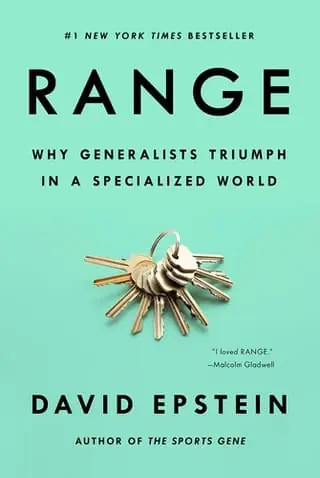
Range summary
by David Epstein · 2019 · 7 key ideas · 19-minute read
In a complex, unpredictable world, people who sample widely, specialise late and connect ideas across fields often outperform early specialists.
Why read it
For anyone who feels behind because they haven't found 'their thing', and for parents and managers pushing early specialisation. It shows when breadth beats a head start, and when it doesn't.
Range in brief
Epstein challenges the popular idea that the path to excellence is to start early, specialise and practise relentlessly. That path, he argues, works well in a narrow set of fields, those with clear rules and quick feedback, like golf or chess. But most of life is messier, and there breadth tends to win.
He shows that many top performers had a 'sampling period': they tried a range of activities before settling on one. In learning, he argues that slow, effortful methods that build flexible understanding beat fast drills that build narrow skills. And he shows how creative breakthroughs often come from people who can draw analogies from distant fields.
Epstein also defends late starters and career switchers. People who try different things find a better 'match quality' between their abilities and their work, which helps them persist and excel. Outsiders often solve problems that stump specialists, precisely because they bring different tools.
He doesn't dismiss expertise. His point is that in a 'wicked' world, where patterns change and feedback is unclear, narrow specialists can become trapped by their own tools. Range, the ability to integrate broadly, is a strength to cultivate, not a detour to apologise for.
The 7 key ideas
1. Roger versus Tiger
Sample before you specialise.
2. Kind and wicked environments
Drills win in tidy games. Range wins in messy ones.
3. Learn slowly to learn well
If it feels easy, you may not be learning.
4. Think in analogies
Collect analogies the way others collect tools.
5. Match quality and the value of quitting
Quitting a bad fit is a skill, not a weakness.
6. Lateral thinking with withered technology
New combinations of old things beat newer things.
7. Outsiders and foxes
Be a fox: many ideas, held loosely.
Read the full guide in Kinquire. Every idea with a real example, a diagram and one thing to try today, plus a quick quiz so it sticks. Free to start.
Read RangeKey takeaways
- Give yourself, or your children, a sampling period before specialising.
- Match your learning approach to whether your field is kind or wicked.
- Use spaced, mixed and effortful practice even when it feels slower.
- Collect analogies from distant fields and use them on stuck problems.
- Treat career changes as experiments that improve your match quality.
Our take
Range is a well-researched and reassuring counterweight to the cult of early specialisation, and its account of kind versus wicked environments and of desirable difficulties rests on solid research. Its limits are those of the genre: inspiring cases of generalists can suffer from survivorship bias, and many fields, from surgery to music performance, still reward deep, early-built skill. Some readers felt the book underplays how hard it is to switch careers without money or connections. Epstein himself argues for range alongside depth, not instead of it.
About David Epstein
David Epstein is an American science journalist who has written for Sports Illustrated and ProPublica. He is also the author of The Sports Gene.
If you liked this
- Outliers by Malcolm Gladwell
- Factfulness by Hans Rosling with Ola Rosling and Anna Rosling Rönnlund
- The Righteous Mind by Jonathan Haidt
- The Anxious Generation by Jonathan Haidt
- David and Goliath by Malcolm Gladwell
- Humankind by Rutger Bregman