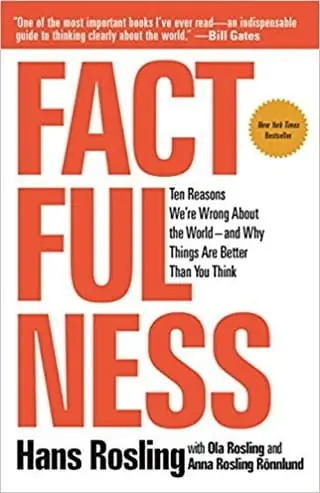
Factfulness summary
by Hans Rosling with Ola Rosling and Anna Rosling Rönnlund · 2018 · 8 key ideas · 21-minute read
The world is far better than most of us think, and our errors come from ten predictable instincts that a few simple habits can tame.
Why read it
For anyone who follows the news and feels the world is falling apart. It gives you a practical toolkit for reading numbers calmly and seeing the world as it actually is.
Factfulness in brief
Rosling opens with a short quiz about basic global trends: poverty, life expectancy, girls' education, vaccination. Educated audiences, including experts and world leaders, score worse than random guessing, which he jokes means chimpanzees picking answers at random would beat them. The errors are not random either: people consistently guess that the world is poorer, sicker and more dangerous than it is.
His explanation is not that people are stupid or that the media is simply biased. Our brains carry dramatic instincts that once helped us survive but now distort how we read information. He names ten of them, from the gap instinct, which splits the world into rich and poor, to the urgency instinct, which pushes us to act before we think.
Each chapter pairs an instinct with a story from his career as a doctor and lecturer and a rule of thumb for controlling it: look for the majority in the middle, compare numbers before reacting, remember that slow change is still change, find causes rather than villains, and take small steps when someone insists you must act now.
The result is what he calls factfulness: a habit of holding opinions only when you have facts to back them. It is not blind optimism. Rosling insists that things can be bad and better at the same time, and he names real global risks worth worrying about. His point is that worry should be aimed at what the data shows, not at what frightens us most.
The 8 key ideas
1. Mind the gap that isn't there
Look for the majority. It usually lives in the middle.
2. Bad and better at once
Bad and better are not opposites.
3. Not every line is straight
Curves come in many shapes. Don't assume a straight line.
4. Fear is not the same as risk
Scary isn't the same as risky. Do the maths.
5. Never trust a lonely number
Compare it. Divide it. Then decide if it's big.
6. Cultures move
Slow change is still change.
7. Look for causes, not villains
Blame ends thinking. Curiosity fixes systems.
8. Urgency is the enemy of good decisions
It's rarely now or never. Take small steps.
Read the full guide in Kinquire. Every idea with a real example, a diagram and one thing to try today, plus a quick quiz so it sticks. Free to start.
Read FactfulnessKey takeaways
- Before reacting to a statistic, compare it with another figure and divide it per person.
- Think in four income levels rather than 'developed versus developing'.
- Expect bad news to be reported and gradual progress to be ignored.
- When you feel the urge to blame someone, list the systems behind the problem.
- Treat urgent demands as a signal to slow down, not speed up.
Our take
Factfulness is a superb corrective to news-driven pessimism, and its rules for reading numbers are useful anywhere. Its quiz is designed to catch people out, so its scores dramatise rather than measure ignorance. Some critics, such as the anthropologist Jason Hickel, argue that the poverty line it relies on is too low and that progress looks less impressive with higher thresholds. Others feel the book underplays inequality, environmental limits and climate risk, though Rosling explicitly names climate change among his top worries. Overall, its central message, that the world is both bad and better, has aged well.
About Hans Rosling with Ola Rosling and Anna Rosling Rönnlund
Hans Rosling was a Swedish doctor and professor of international health who co-founded the Gapminder Foundation with his son Ola and daughter-in-law Anna. He died in 2017, shortly before the book was published.
If you liked this
- Enlightenment Now by Steven Pinker
- Thinking, Fast and Slow by Daniel Kahneman
- The Righteous Mind by Jonathan Haidt
- The Anxious Generation by Jonathan Haidt
- Outliers by Malcolm Gladwell
- David and Goliath by Malcolm Gladwell