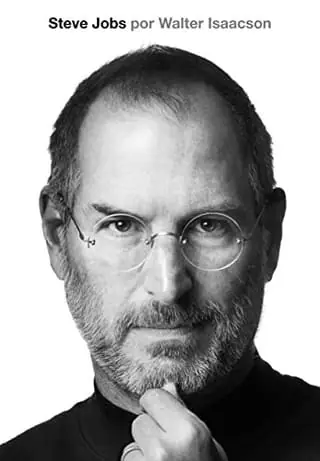
Steve Jobs summary
by Walter Isaacson · 2011 · 7 key ideas · 18-minute read
The authorized life of Apple's co-founder: a brilliant, difficult perfectionist who joined art and technology and remade several industries.
Why read it
For anyone who builds products, leads teams or wonders what drives exceptional work — and what it costs the people around it.
Steve Jobs in brief
Steve Jobs was adopted as a baby by Paul and Clara Jobs and grew up in what became Silicon Valley. His father, a machinist, taught him to care about craftsmanship, even in parts no one sees. He dropped out of Reed College, wandered into a calligraphy class, travelled to India and absorbed Zen Buddhism — influences that later shaped Apple's taste for simplicity.
In 1976 he and Steve Wozniak founded Apple in the Jobs family garage. Wozniak was the engineering genius; Jobs supplied vision, marketing and an unshakeable will. The Apple II made them rich, and the 1984 Macintosh brought a friendly graphical computer to ordinary people. But Jobs's abrasiveness and power struggles led the board to side with CEO John Sculley, and in 1985 he was pushed out.
The exile years were humbling and formative. He founded NeXT, which struggled commercially, and bought a small graphics division from Lucasfilm that became Pixar. Pixar's Toy Story in 1995 made him a billionaire. When Apple, close to failure, bought NeXT in 1997, Jobs returned and soon took charge.
His second act was one of the great turnarounds in business history. He slashed the product line, partnered with designer Jony Ive, and launched the iMac, the Apple Stores, the iPod and iTunes, the iPhone and the iPad. Each product reflected his obsession with simplicity and with controlling the whole experience end to end.
Isaacson does not hide the darker side: cruelty to colleagues, a denial of paternity of his first daughter Lisa that he later regretted, and a nine-month delay before surgery for pancreatic cancer while he tried alternative treatments. Jobs died in October 2011. The portrait is of a man whose genius and flaws were tightly intertwined.
The 7 key ideas
1. The reality distortion field
Ask whether a limit is physics or just habit.
2. Craft the parts no one sees
Paint the back of the fence.
3. Focus means saying no
Four great things beat forty decent ones.
4. Where art meets technology
Taste is a technology too.
5. Control the whole widget
Own the experience, not just the part.
6. Cannibalize yourself
Eat your own lunch before someone else does.
7. A players and brutal honesty
Be hard on the work, not on the person.
Read the full guide in Kinquire. Every idea with a real example, a diagram and one thing to try today, plus a quick quiz so it sticks. Free to start.
Read Steve JobsKey takeaways
- Before accepting a limit, ask whether it is physical or merely a habit.
- Cut your projects to the few you can make excellent.
- Care about the hidden details; quality is a single standard.
- Borrow ideas from outside your field — art, history, design.
- Build the thing that could replace your own success.
- Be honest about work, but don't confuse cruelty with standards.
Our take
Isaacson had unusual access and interviewed Jobs, his family, friends and rivals, so the book is rich and balanced in tone. It captures both the genius and the cruelty. Critics, including some Apple insiders such as Tim Cook and Jony Ive, felt it dwelt too heavily on Jobs's temper and under-described how he matured and how he worked day to day as a leader. Others note it is stronger on narrative than on analysing Apple's strategy. Becoming Steve Jobs by Brent Schlender and Rick Tetzeli offers a gentler counterpoint.
About Walter Isaacson
Walter Isaacson is a former managing editor of Time and CEO of CNN who has also written biographies of Benjamin Franklin, Albert Einstein and Leonardo da Vinci. Jobs asked him to write this book and gave him dozens of interviews while placing no control over the text.
If you liked this
- Elon Musk by Walter Isaacson
- Sapiens by Yuval Noah Harari
- Guns, Germs, and Steel by Jared Diamond
- The Silk Roads by Peter Frankopan
- SPQR by Mary Beard
- The Rise and Fall of the Third Reich by William L. Shirer