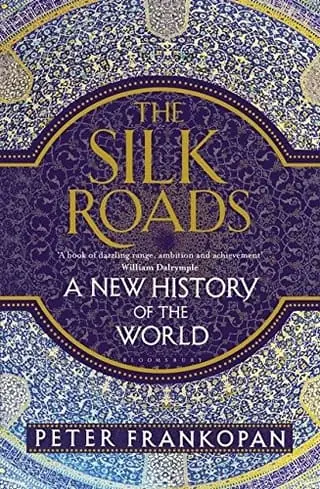
The Silk Roads summary
by Peter Frankopan · 2015 · 7 key ideas · 17-minute read
World history retold from its true centre — the web of routes linking Europe, Asia and Africa through Persia and Central Asia.
Why read it
If your mental map of history runs Greece–Rome–Europe–America, this book redraws it. It's ideal for understanding why the Middle East and Central Asia matter so much today.
The Silk Roads in brief
Frankopan argues that the standard Western story of history — from ancient Greece to Rome, Christian Europe, the Renaissance and the rise of the West — leaves out the region that was actually the world's centre for most of history: the lands from the eastern Mediterranean through Persia and Central Asia to China.
Along these 'silk roads' moved far more than silk. Religions travelled them — Buddhism, Christianity, Islam and others. So did furs, slaves, silver, horses, ideas, scientific knowledge and disease. Cities like Baghdad, Samarkand and Merv were the wealthiest and most sophisticated places on earth while Western Europe was a backwater.
Western Europe's rise, in Frankopan's telling, came late and was driven by violence, luck and access: Atlantic explorers seized the wealth of the Americas and built sea routes to Asia. In the twentieth century, oil drew the great powers back to the heart of the world, and their rivalry over it shaped wars, coups and revolutions.
The book closes with the region rising again. As the West's dominance weakens, China and others are rebuilding connections across Asia. For Frankopan, the silk roads are not a romantic past but the main story of history — and of our future.
The 7 key ideas
1. Move the centre of the map
History looks different from the middle of the map.
2. Roads carry beliefs, not just goods
Where goods go, gods go.
3. Furs, slaves and silver
Follow the silver to find history's hidden routes.
4. Networks spread disaster too
Every road that brings riches can also bring ruin.
5. The West rose by reaching around
Behind every 'rise' is someone else's resources.
6. Oil pulled the powers back
Today's headlines often grew from yesterday's oil wells.
7. The roads are rising again
History's hub has moved before. It's moving again.
Read the full guide in Kinquire. Every idea with a real example, a diagram and one thing to try today, plus a quick quiz so it sticks. Free to start.
Read The Silk RoadsKey takeaways
- Re-centre your map: ask how a story looks from Persia, Central Asia or China.
- Follow the money — and the silver — to see who really powered a historical change.
- Remember that networks spread shocks as fast as wealth; build buffers.
- Read the long history behind today's Middle East headlines.
- Add non-Western news sources to your regular reading.
Our take
The Silk Roads is a powerful corrective to Eurocentric history and a gripping read, packed with connections most readers have never considered. Its breadth comes at a cost: specialists note simplifications, and the 'silk roads' label stretches to cover almost every exchange in Eurasia. Several reviewers felt the second half becomes a story of Western intervention — oil, empire and the Cold War — rather than one told from the region's own perspective, with less on China, India and Africa than the opening promises. Its closing forecasts about the East's rise are still being tested by events.
About Peter Frankopan
Peter Frankopan is a British historian at the University of Oxford, where he specialises in Byzantine and global history. The Silk Roads became an international bestseller, and he followed it with The New Silk Roads (2018).
If you liked this
- Genghis Khan and the Making of the Modern World by Jack Weatherford
- Guns, Germs, and Steel by Jared Diamond
- Sapiens by Yuval Noah Harari
- SPQR by Mary Beard
- The Rise and Fall of the Third Reich by William L. Shirer
- 1776 by David McCullough