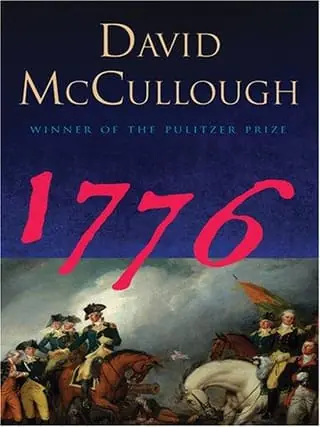
1776 summary
by David McCullough · 2005 · 7 key ideas · 17-minute read
The year America declared independence was also the year its ragged army nearly lost the war — and how it survived.
Why read it
A vivid, human story of leadership under pressure. If you think history's outcomes were inevitable, this book shows how close the American Revolution came to collapse, and what kept it alive.
1776 in brief
McCullough tells the story of the American Revolution's most dramatic year almost entirely through its soldiers and generals, on both sides. He opens in London in October 1775, with King George III declaring to Parliament that the colonies are in open rebellion and must be brought back by force.
In America, George Washington commands an untrained, poorly supplied army besieging the British in Boston. With cannon dragged hundreds of miles from Fort Ticonderoga, his troops fortify Dorchester Heights overnight, and in March 1776 the British evacuate the city. It's a triumph — and the last good news for months.
The British return with a huge fleet and army to New York. Washington is outmanoeuvred on Long Island, saves his army only by a daring night retreat, then loses Manhattan, Fort Washington and much of New Jersey. By December, his army is shrinking, enlistments are ending, and the cause looks lost.
Then, on the night of Christmas 1776, Washington crosses the icy Delaware River and surprises the Hessian garrison at Trenton, following up with another victory at Princeton in early January. These small wins revive a dying cause. McCullough's message: the outcome was never certain, and perseverance mattered more than brilliance.
The 7 key ideas
1. Nothing was inevitable
History is only obvious looking backwards.
2. Amateurs who learned fast
Initiative can outrun credentials.
3. Great leaders make big mistakes
Judge a leader by how they recover, not whether they err.
4. A good retreat saves the war
Live to fight another day — and make sure there is another day.
5. Endurance beats brilliance
The underdog wins by still being there.
6. Small wins revive a cause
One small victory can change what people believe is possible.
7. Know the other side
Understand your rival's fears as well as their strengths.
Read the full guide in Kinquire. Every idea with a real example, a diagram and one thing to try today, plus a quick quiz so it sticks. Free to start.
Read 1776Key takeaways
- Don't read success backwards — remember how close things came to failing.
- Back people with initiative, even without credentials.
- Treat mistakes as lessons and keep going.
- When outmatched, preserve your resources and play for time.
- Engineer a small, visible win to revive a flagging team.
Our take
1776 is a superb narrative: brisk, humane and grounded in letters and diaries from both sides. It makes Washington fallible and the Revolution's survival feel genuinely uncertain. Its focus is deliberately narrow — military events of one year — so the Declaration, Congress's politics, loyalists' experiences, Native Americans and enslaved people get little attention. Some academic historians see McCullough's approach as admiring and leader-centred rather than analytical. As a gripping introduction to the war's darkest year, though, it has held up well.
About David McCullough
David McCullough was an American historian and one of the most widely read narrative writers of his time. He won two Pulitzer Prizes, for biographies of Harry Truman and John Adams.
If you liked this
- Sapiens by Yuval Noah Harari
- Guns, Germs, and Steel by Jared Diamond
- The Silk Roads by Peter Frankopan
- SPQR by Mary Beard
- The Rise and Fall of the Third Reich by William L. Shirer
- The Guns of August by Barbara W. Tuchman