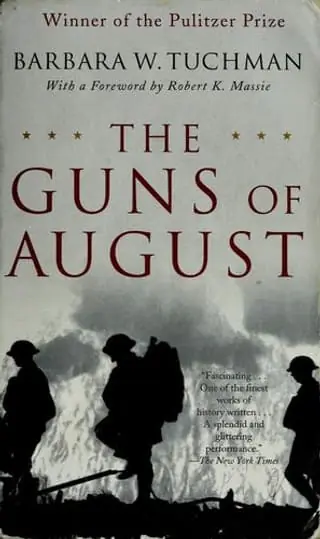
The Guns of August summary
by Barbara W. Tuchman · 1962 · 7 key ideas · 17-minute read
The first month of the First World War, when rigid plans, false assumptions and human error turned an expected short war into four years of slaughter.
Why read it
A masterclass in how smart, confident leaders walk into disaster. It's essential for anyone who makes plans under uncertainty — which is to say, everyone.
The Guns of August in brief
Tuchman opens in May 1910 at the funeral of King Edward VII, where nine reigning kings rode behind the coffin — a dazzling image of an old European order that, within a few years, would tear itself apart.
She then dissects the war plans each great power had prepared for years: Germany's scheme to knock out France by sweeping through Belgium, France's faith in all-out attack, Britain's half-secret commitments, and Russia's slow mobilisation. When crisis came in the summer of 1914, these plans took on a momentum of their own.
The heart of the book is August 1914 itself. Belgium refuses to let German armies pass and fights back. French offensives are cut down. The small British army retreats. In the east, Russia invades Germany and suffers a catastrophic defeat at Tannenberg. German atrocities in Belgium, including the burning of Louvain, turn world opinion.
By early September the German armies are near Paris. Then a gap opens between them, the French and British counter-attack on the Marne, and the Germans fall back. Tuchman argues that this battle ended any hope of a quick victory and locked Europe into a long war of attrition whose consequences shaped the whole century.
The 7 key ideas
1. A gilded order on the edge
Pageantry isn't stability.
2. Plans become prisons
A plan you can't change is a plan that controls you.
3. Doctrine blinds you to evidence
The theory you love most is the one you'll check least.
4. The weak can upset the strong
Never assume the small player will step aside.
5. The short-war illusion
Plan for the long war, hope for the short one.
6. Friction decides battles
Wars and projects are lost in the small print.
7. Composure at the crisis
In a crisis, the calmest person sees the gap first.
Read the full guide in Kinquire. Every idea with a real example, a diagram and one thing to try today, plus a quick quiz so it sticks. Free to start.
Read The Guns of AugustKey takeaways
- Build flexibility into your plans so they can change when reality does.
- Test your strongest beliefs against contrary evidence.
- Don't assume weaker parties will simply comply.
- Plan for things to take longer than you hope.
- In a crisis, pause to look for the opening others miss.
Our take
The Guns of August remains one of the most readable works of military history ever written, with unforgettable portraits and a sharp eye for human error. Its narrow frame — the opening month — means the July 1914 crisis and the deeper causes of the war get little attention. Later historians, from Fritz Fischer's arguments about German war aims to Christopher Clark's The Sleepwalkers, have offered more complex views of responsibility. Some of Tuchman's character sketches lean toward caricature, and specialists have questioned particular details. But her central insight — that rigid plans and shared illusions drove leaders into catastrophe — still stands.
About Barbara W. Tuchman
Barbara W. Tuchman was an American historian and writer who worked outside academia. She won the Pulitzer Prize twice, for The Guns of August and for Stilwell and the American Experience in China.
If you liked this
- The Sleepwalkers by Christopher Clark
- Sapiens by Yuval Noah Harari
- Guns, Germs, and Steel by Jared Diamond
- The Silk Roads by Peter Frankopan
- SPQR by Mary Beard
- The Rise and Fall of the Third Reich by William L. Shirer