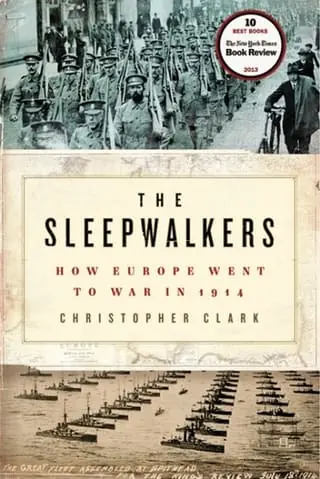
The Sleepwalkers summary
by Christopher Clark · 2012 · 7 key ideas · 17-minute read
How Europe's leaders, each acting rationally in their own eyes, walked step by step into the First World War — with no single villain to blame.
Why read it
A brilliant study of how complex systems drift into catastrophe. Essential for understanding 1914 — and for anyone making high-stakes decisions in a world of many players and imperfect information.
The Sleepwalkers in brief
Clark asks not why the First World War happened — which tends to lead to blaming one country — but how it happened: the sequence of decisions, misreadings and interactions that turned an assassination in Sarajevo into a continental war within five weeks.
He begins in Serbia, where a 1903 coup by army officers brought a new dynasty to power and left a network of nationalist conspirators inside the state. One of them later helped arm the young Bosnian Serbs who assassinated Archduke Franz Ferdinand, heir to the Austro-Hungarian throne, in June 1914.
Clark then shows how Europe had divided into two alliance blocs, how Balkan conflicts became linked to the great powers' commitments, and how decision-making in every capital was fragmented among rival ministers, generals and monarchs, making intentions hard to read.
Finally, he traces the July Crisis day by day. Every government made choices that narrowed the options, often while believing it was acting defensively. His conclusion: the war was a tragedy, not a crime. The leaders of 1914 were 'sleepwalkers' — watchful, but blind to the horror they were about to unleash.
The 7 key ideas
1. Ask 'how', not 'why'
Ask how before you ask who.
2. A state within a state
Beware power that answers to no one.
3. Many voices, no clear signal
Mixed signals breed misreadings.
4. How a local war goes global
Alliances that deter can also entangle.
5. The wrong turn in Sarajevo
History turns on wrong turns.
6. Fear of looking weak
Pride can push you where reason would not go.
7. A tragedy, not a crime
Catastrophes are often group projects.
Read the full guide in Kinquire. Every idea with a real example, a diagram and one thing to try today, plus a quick quiz so it sticks. Free to start.
Read The SleepwalkersKey takeaways
- Map how a disaster happened before deciding who to blame.
- Send clear, consistent signals to people who must read your intentions.
- Review commitments that could pull you into others' conflicts.
- Check whether fear of looking weak is driving your choices.
- Own your part in shared failures.
Our take
The Sleepwalkers is widely admired for its depth of research across many national archives, its vivid portraits and its insight into how fragmented decision-making produces disaster. It has been criticised, however, for distributing blame so widely that Germany and Austria-Hungary's decisive choices — Austria's ultimatum and Germany's 'blank cheque' — may seem less central than they were. Some argue it gives too much weight to Serbia, Russia and France. Even critics agree it is essential reading, and its warning about multipolar crises still resonates.
About Christopher Clark
Christopher Clark is an Australian-born historian who works at the University of Cambridge, where he became Regius Professor of History. He is a specialist in Prussian and German history.
If you liked this
- The Guns of August by Barbara W. Tuchman
- Sapiens by Yuval Noah Harari
- Guns, Germs, and Steel by Jared Diamond
- The Silk Roads by Peter Frankopan
- SPQR by Mary Beard
- The Rise and Fall of the Third Reich by William L. Shirer