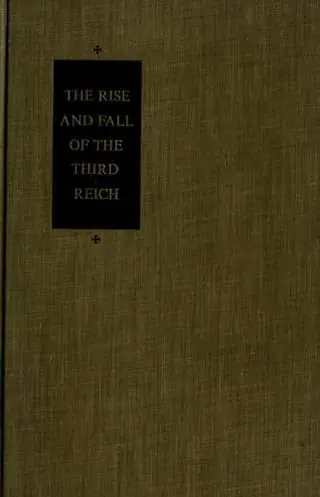
The Rise and Fall of the Third Reich summary
by William L. Shirer · 1960 · 7 key ideas · 18-minute read
An eyewitness journalist uses the Nazis' own captured documents to tell how Hitler seized Germany, plunged the world into war and destroyed himself and millions of others.
Why read it
The classic one-volume narrative of Nazi Germany: gripping, morally clear and built on the regime's own records. It's a lesson in how democracies can be dismantled and how evil gets organised.
The Rise and Fall of the Third Reich in brief
Shirer had watched Nazi Germany up close as a reporter. After the war, the Allies captured huge quantities of German government and military documents, many used at the Nuremberg trials. Shirer combined these records, diaries and testimony with his own memories to write a single history of the Third Reich from start to finish.
The first part follows Hitler's rise: a failed Austrian artist and First World War veteran who built a mass movement in the chaos of Weimar Germany, failed in a coup in 1923, and then pursued power through elections. In January 1933 conservative politicians made him chancellor, believing they could control him. Within months he had destroyed democracy.
Shirer then charts Hitler's bluffs and gambles in the 1930s — rearmament, the Rhineland, Austria, Czechoslovakia — as Britain and France backed away. The pact with Stalin cleared the way for the invasion of Poland in 1939, and lightning victories followed.
But Hitler overreached: invading the Soviet Union in 1941, declaring war on the United States, and overruling his generals. Shirer documents the horrors of the Nazi 'New Order', including the systematic murder of Europe's Jews, the failed July 1944 plot, and Hitler's suicide in his Berlin bunker in April 1945.
The 7 key ideas
1. He told you what he'd do
When the powerful tell you their plans, believe them.
2. Power was handed over, not won
Those who think they can use extremists usually get used.
3. Democracy dismantled by law
Tyranny often arrives with paperwork, not tanks.
4. Bluffs work until someone calls them
Every unanswered bluff buys the next one.
5. The elites who could have stopped him
Dictators need permission from those who could say no.
6. Overreach is built in
Winning streaks make the worst advisers.
7. Evil kept records
Atrocity needs a bureaucracy; refusal needs only a person.
Read the full guide in Kinquire. Every idea with a real example, a diagram and one thing to try today, plus a quick quiz so it sticks. Free to start.
Read The Rise and Fall of the Third ReichKey takeaways
- Take powerful people at their word when they announce extreme plans.
- Distrust anyone who says a dangerous figure 'can be managed'.
- Learn how emergency powers work in your country before they're needed.
- Hold small boundaries early — appeasement gets more expensive over time.
- Remember that your cooperation, or refusal, matters.
Our take
Shirer's book remains a gripping, morally serious narrative with an unmatched eyewitness voice, and it brought the captured German documents to a mass audience. But historians have criticised it on several fronts. His argument that Nazism was a natural outgrowth of German history and character — a line running from Luther onward — is widely rejected as too simple. He focuses on Hitler and the leadership, with little on German society, economics or women's lives, and the Holocaust is less central than in later scholarship. Works by Ian Kershaw and Richard J. Evans offer more nuanced, up-to-date accounts.
About William L. Shirer
William L. Shirer was an American journalist who reported from Nazi Berlin in the 1930s, including as a radio correspondent for CBS, and wrote the bestselling Berlin Diary (1941). The Rise and Fall of the Third Reich won the U.S. National Book Award in 1961.
If you liked this
- Sapiens by Yuval Noah Harari
- Guns, Germs, and Steel by Jared Diamond
- The Silk Roads by Peter Frankopan
- SPQR by Mary Beard
- 1776 by David McCullough
- The Guns of August by Barbara W. Tuchman