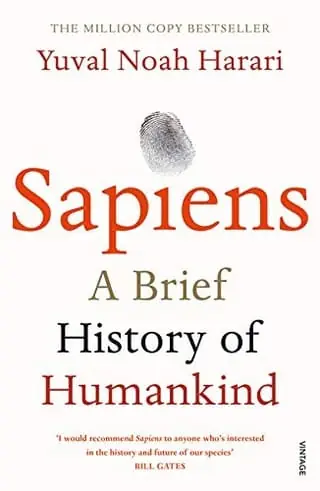
Sapiens summary
by Yuval Noah Harari · 2011 · 7 key ideas · 20-minute read
How an unremarkable ape came to rule the planet by believing in shared stories — and whether that power ever made us happier.
Why read it
For anyone who wants the whole sweep of human history in one framework: it changes how you see money, nations, companies and religions, and gives you plenty to argue with.
Sapiens in brief
Harari tells the story of our species through three revolutions. About 70,000 years ago a Cognitive Revolution gave Homo sapiens a new kind of language, one that could describe things that don't exist. That ability to believe shared fictions let strangers cooperate in huge numbers, and it is why we, rather than Neanderthals or any other human species, spread across the globe.
About 12,000 years ago came the Agricultural Revolution. Harari calls it a trap: farming produced more food and more people, but for most individuals it meant harder work, worse diets, disease and hierarchy. Once populations grew, there was no way back.
To manage millions of people, humans built 'imagined orders' — law, writing, money, empires and religions. Money, in particular, became the most universal system of trust ever invented. Slowly these orders pulled the world's many cultures toward a single global civilisation.
About 500 years ago the Scientific Revolution began when Europeans admitted how much they didn't know. Science, empire and capitalism fed each other: explorers mapped, scientists studied, investors financed, and belief in future growth unlocked credit on a new scale.
Harari ends by asking whether all this power made us happier — and by warning that biotechnology and computing may soon let Sapiens redesign itself, turning history's next chapter into one written by something no longer quite human.
The 7 key ideas
1. Fiction is our superpower
Nations, brands and money are stories we agree to keep telling.
2. We were not alone
We are the last humans standing — not the only ones who ever stood.
3. History's biggest fraud
Today's luxury is tomorrow's necessity — and the day after's obligation.
4. Imagined orders run the world
Equality and hierarchy are both stories; we choose which to enforce.
5. Money: trust made universal
Money isn't metal or paper. It's trust you can carry.
6. The discovery of ignorance
Admitting ignorance is where real knowledge starts.
7. Power without happiness
More power isn't more peace.
Read the full guide in Kinquire. Every idea with a real example, a diagram and one thing to try today, plus a quick quiz so it sticks. Free to start.
Read SapiensKey takeaways
- Notice the shared stories — money, nations, companies — that quietly organise your life.
- Watch for luxury traps: conveniences that turn into obligations.
- Treat social rules as human-made, which means they can be changed.
- Practise saying 'I don't know' as the first step to learning.
- Measure progress by wellbeing, not just power or wealth.
Our take
Sapiens is brilliant at making the very long view vivid and at showing how much of our world rests on shared belief. Its weakness is the flip side: sweeping claims delivered with confidence where specialists see much more nuance. Anthropologists and historians have criticised its treatment of foragers as romanticised, its loose use of 'fiction', and some factual shortcuts. Newer archaeology, popularised in The Dawn of Everything, questions the neat 'trap' story of farming. Read it as a thought-provoking framework rather than a settled account — it's excellent for questions, less reliable for final answers.
About Yuval Noah Harari
Yuval Noah Harari is an Israeli historian who earned his doctorate at Oxford and teaches at the Hebrew University of Jerusalem. Sapiens first appeared in Hebrew in 2011 and in English in 2014.
If you liked this
- Homo Deus by Yuval Noah Harari
- Guns, Germs, and Steel by Jared Diamond
- The Dawn of Everything by David Graeber and David Wengrow
- The Silk Roads by Peter Frankopan
- SPQR by Mary Beard
- The Rise and Fall of the Third Reich by William L. Shirer