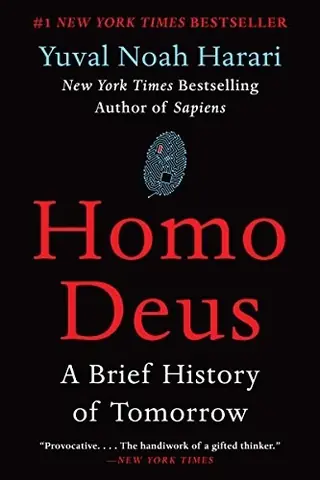
Homo Deus summary
by Yuval Noah Harari · 2015 · 7 key ideas · 19-minute read
Having largely tamed famine, plague and war, humanity may now chase immortality, bliss and god-like powers — and in doing so hand authority from human feelings to algorithms.
Why read it
For anyone who wants a big-picture frame for the 21st century: where our values came from, why biotech and AI challenge them, and which questions we should be asking now.
Homo Deus in brief
Harari opens with a bold claim: for most of history, famine, plague and war were the top items on humanity's agenda, treated as acts of God. Today they have become manageable problems. More people now die from overeating than from hunger, and from old age than from infectious disease. When an old agenda is largely met, a new one appears.
That new agenda, he suggests, is to overcome death, engineer lasting happiness and upgrade ourselves into something like gods — Homo Deus. He stresses that this is a possibility to discuss, not a prophecy. Studying history, in his view, is not about predicting the future but about loosening the grip of the past so we can imagine other futures.
To explain how we got here, Harari revisits what made Sapiens powerful: cooperation in large numbers, held together by shared stories such as gods, money and nations. Modern society struck a deal — give up the belief in a cosmic plan in exchange for power — and filled the meaning gap with humanism, the faith that human feelings and choices are the ultimate source of authority.
The final third argues that 21st-century science is quietly undermining that faith. If organisms are algorithms and the 'free, unified self' is a story the brain tells, then algorithms that know us better than we know ourselves may earn the authority we once gave our feelings. Intelligence is decoupling from consciousness, which could make many people economically unnecessary.
Harari ends with a possible new religion, Dataism, which values everything by its contribution to data processing. He closes with three questions rather than answers: are organisms really just algorithms, what matters more — intelligence or consciousness — and what happens when non-conscious algorithms know us better than we do?
The 7 key ideas
1. The new human agenda
Solve one agenda and ambition writes the next.
2. Study history to escape it
History doesn't tell you where to go; it shows you the door.
3. Fictions that bind
Stories steer us — but only beings that feel can suffer.
4. The modern deal: power for meaning
We swapped the cosmic script for the steering wheel.
5. The self is a story
You live one story and remember another.
6. Intelligence without consciousness
Employers buy intelligence; only we bring consciousness.
7. Dataism: the next religion?
An unshared moment isn't wasted — it's simply yours.
Read the full guide in Kinquire. Every idea with a real example, a diagram and one thing to try today, plus a quick quiz so it sticks. Free to start.
Read Homo DeusKey takeaways
- Treat the future as a set of choices to debate now, not a forecast to wait for.
- Separate shared stories (brands, nations, money) from things that can actually suffer.
- Notice when your 'narrating self' overrides what you actually experienced.
- Audit which decisions you've handed to algorithms and reclaim at least one.
- Protect experiences you don't record or share.
Our take
Homo Deus is brilliant at zooming out and connecting religion, economics and biology into one readable story, and its questions about AI and authority now feel prescient. But it moves fast and sometimes presents contested claims — that free will is an illusion, that humanism is a religion, that a 'useless class' is coming — with more confidence than the evidence allows. Its opening optimism about war and plague looks dated after the 2020s. Read it as a provocation and a map of possibilities, which is how Harari frames it, rather than as a forecast.
About Yuval Noah Harari
Yuval Noah Harari is an Israeli historian who teaches at the Hebrew University of Jerusalem. He is best known for Sapiens, of which Homo Deus is a forward-looking sequel.
If you liked this
- Sapiens by Yuval Noah Harari
- Nexus by Yuval Noah Harari
- Life 3.0 by Max Tegmark
- Superintelligence by Nick Bostrom
- Human Compatible by Stuart Russell
- The Coming Wave by Mustafa Suleyman with Michael Bhaskar