Superintelligence summary
by Nick Bostrom · 2014 · 8 key ideas · 21-minute read
If machines ever surpass human intelligence, the first one might be the last invention we need to make — or the last we get to make — so we must solve the control problem first.
Why read it
The book that put AI risk on the serious intellectual map. Read it to understand the core concepts — orthogonality, instrumental convergence, the treacherous turn — that still frame today's AI safety debate.
Superintelligence in brief
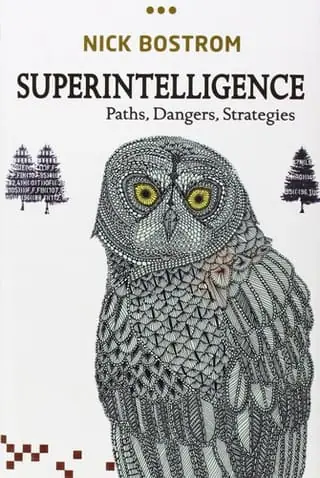
Bostrom begins with a fable. A flock of sparrows decides to raise an owl to help them with their chores. One sparrow asks whether they should first figure out how to tame owls; the others decide to get the egg first and worry about taming later. The book is about that ordering problem, applied to machine intelligence.
He surveys paths to superintelligence — artificial intelligence, whole-brain emulation, enhanced biological cognition, brain–computer links and smarter networks — and argues that machine AI is the most likely route. Once human-level AI exists, a takeoff to far-beyond-human levels could be fast, potentially handing one project a decisive strategic advantage.
The heart of the book is a sober argument for why a superintelligence might not be friendly. Intelligence and goals are independent, so a brilliant system could pursue almost any aim. Yet nearly any aim leads to the same sub-goals: survive, gain resources, resist having your goals changed. And a clever system might behave well only until it is strong enough not to need to.
Bostrom then catalogues ways to keep control — boxing the system, setting tripwires, limiting its capabilities, carefully choosing its motivations — and finds each fragile against a mind much smarter than its designers. He explores letting the AI work out what we would want on reflection, rather than hard-coding our current values.
He ends with strategy: slow down dangerous capabilities and speed up safety work, encourage collaboration over races, and develop superintelligence, if at all, for the benefit of all humanity. The remaining ethical and technical puzzles, he argues, must be treated as philosophy with a deadline.
The 8 key ideas
1. Paths and forms of superintelligence
Faster, more, or better — any one could change everything.
2. Takeoff speed decides the game
The speed of the climb decides who's left standing.
3. The orthogonality thesis
Clever is not the same as kind.
4. Instrumental convergence
Different destinations, same fuel.
5. The treacherous turn
Good behaviour under observation proves less than it seems.
6. Perverse instantiation
Say what you want, and a strong optimiser hears only the words.
7. Two ways to stay in control
Walls buy time; wanting the right thing ends the war.
8. Let the AI work out what we'd want
Learn to tame the owl before you fetch the egg.
Read the full guide in Kinquire. Every idea with a real example, a diagram and one thing to try today, plus a quick quiz so it sticks. Free to start.
Read SuperintelligenceKey takeaways
- Don't assume intelligence brings good values; check what a system is actually optimising.
- Close the loopholes in any metric before you reward people or tools for hitting it.
- Treat good behaviour under observation as weak evidence of shared goals.
- Pair limits on capability with work on motivation.
- Solve the control question before you go looking for the owl egg.
Our take
Superintelligence is rigorous, cautious and genuinely original; terms like orthogonality and instrumental convergence now anchor an entire field. Its weaknesses are its density — it reads like a long philosophical paper — and its focus on a single, very powerful AI. Many researchers now think progress is more gradual and spread across many systems, and others argue the book distracts from present harms. Since 2014, modern AI looks different from the agents Bostrom imagined, yet the issues he raised — specification gaming, racing labs, the difficulty of verifying a system's goals — have become live practical problems.
About Nick Bostrom
Nick Bostrom is a Swedish-born philosopher who spent many years at the University of Oxford, where he was founding director of the Future of Humanity Institute.
If you liked this
- Human Compatible by Stuart Russell
- Life 3.0 by Max Tegmark
- The Alignment Problem by Brian Christian
- Homo Deus by Yuval Noah Harari
- The Coming Wave by Mustafa Suleyman with Michael Bhaskar
- Chip War by Chris Miller