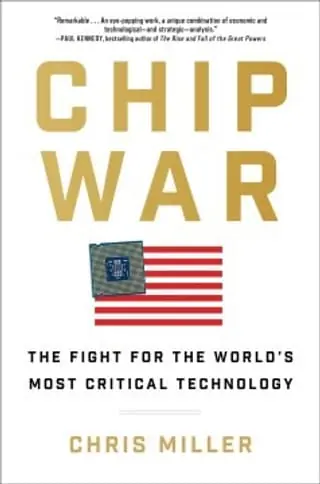
Chip War summary
by Chris Miller · 2022 · 8 key ideas · 21-minute read
The modern world runs on semiconductors, and the history of who designs and makes them explains much of the global balance of power — from the Cold War to the US–China rivalry.
Why read it
For anyone who wants to understand why tiny chips have become a geopolitical flashpoint, why Taiwan matters so much, and how a few companies became chokepoints for the entire world economy.
Chip War in brief
Miller argues that semiconductors are the new oil: everything from phones to missiles to cars depends on them, and their production is concentrated in a handful of places. Unlike oil, however, cutting-edge chips can be made by only a few companies, using machines that only one firm can build.
The story begins in post-war America. The transistor and then the integrated circuit were invented by American scientists, and the US military and space programme were the first big customers. Entrepreneurs in what became Silicon Valley turned chips into a mass-market product, while Moore's Law — the doubling of transistors per chip — drove relentless progress.
To cut costs, US firms moved assembly to East Asia, weaving Taiwan, South Korea, Singapore and Japan into America's technological orbit. The Soviet Union tried to copy American chips and fell hopelessly behind; the result showed up in precision weapons. Japan, meanwhile, challenged and briefly beat US chipmakers in the 1980s, forcing companies like Intel to reinvent themselves.
The pivotal move came from Morris Chang, who founded TSMC in Taiwan to manufacture chips designed by others. This foundry model let a wave of design-only companies flourish and left the world dependent on Taiwan for its most advanced chips. Meanwhile, the machines to make them came to rely on a single Dutch firm, ASML.
The book closes with China: its massive chip imports, its drive for self-sufficiency, and US efforts to block its access to advanced technology. Miller warns that a crisis over Taiwan could disrupt the world economy on a scale few have imagined.
The 8 key ideas
1. Chips are the new oil
Whoever holds the chokepoint holds the leverage.
2. Born from the military
Early buyers who pay too much build tomorrow's cheap tech.
3. Moore's Law and the mass market
Small doublings, relentlessly repeated, change the world.
4. Copying isn't catching up
If you're copying the leader, you're learning yesterday's lesson.
5. Japan's challenge and Intel's pivot
Ask what a newcomer would quit — then quit it first.
6. The foundry revolution
Make for everyone, and you learn from everyone.
7. The machine only one company makes
One machine, one company — and the whole future waits in line.
8. The new chip war
Power now flows through silicon.
Read the full guide in Kinquire. Every idea with a real example, a diagram and one thing to try today, plus a quick quiz so it sticks. Free to start.
Read Chip WarKey takeaways
- Map the chokepoints in any system you depend on, from supply chains to careers.
- Remember that early, expensive customers fund the cheap technology of the future.
- Copying keeps you a step behind; build your own edge.
- Be willing to abandon a core business when it becomes a losing fight.
- Follow chip news to understand where global power is heading.
Our take
Chip War is a gripping, well-researched history that makes an obscure industry legible, with vivid characters and clear stakes. Its US-centric lens means it sometimes treats American dominance as the natural baseline, and it offers fewer perspectives from Chinese, Korean or Taiwanese sources. Some readers find its policy conclusions hawkish. Events since 2022 — sweeping export controls, government subsidies for domestic fabs, and the AI boom's hunger for advanced chips — have strongly borne out its core claim that semiconductors are central to geopolitics.
About Chris Miller
Chris Miller is an economic historian who teaches at the Fletcher School at Tufts University. Chip War won the Financial Times Business Book of the Year award in 2022.
If you liked this
- The Innovators by Walter Isaacson
- AI Superpowers by Kai-Fu Lee
- The Coming Wave by Mustafa Suleyman with Michael Bhaskar
- Homo Deus by Yuval Noah Harari
- Life 3.0 by Max Tegmark
- Superintelligence by Nick Bostrom