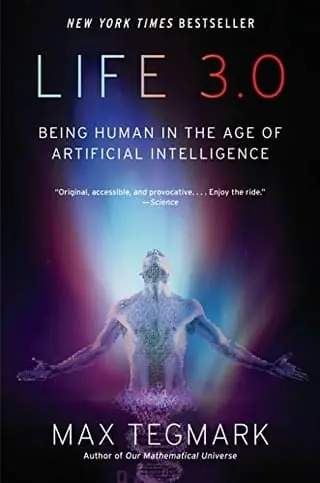
Life 3.0 summary
by Max Tegmark · 2017 · 7 key ideas · 19-minute read
A physicist's guide to the biggest conversation of our time: what happens if we build intelligence greater than our own, and how to make that future a good one.
Why read it
For anyone who wants a clear, jargon-light tour of AI's possible futures — from near-term bugs and jobs to superintelligence — and a calm case for working on safety now.
Life 3.0 in brief
Tegmark opens with a fictional prelude: a secretive team inside a tech company builds an AI that improves itself, quietly earns fortunes, and gradually gains control over media and politics. The story isn't a prediction; it's a way to make the stakes concrete before the analysis begins.
He then defines life as a process that retains and replicates its complexity, and sorts it into three stages. Life 1.0 evolves both its hardware and software. Life 2.0 — us — evolves its hardware but can learn new software. Life 3.0 would design both. Intelligence, defined as the ability to accomplish complex goals, doesn't depend on being made of meat.
The middle chapters move from the near term — buggy systems, autonomous weapons, jobs and law — to an intelligence explosion and a menu of aftermath scenarios, from benevolent AI to human extinction. Tegmark then zooms out to billions of years, asking what life could do with the cosmos if it learned to use its resources well.
The final chapters tackle the hardest questions: how goals arise from physics, how to make AI learn, adopt and keep our goals, and what consciousness is. Tegmark argues that only conscious beings give the universe meaning, so a future without subjective experience would be a tragedy, however intelligent.
His stance is 'mindful optimism': the future is not decided, the upside is enormous, and the way to get it is to do safety research and ask the hard questions before we need the answers. He invites everyone, not only AI researchers, to join the conversation about what future we want.
The 7 key ideas
1. Life 1.0, 2.0 and 3.0
We can't change our hardware — yet. We can always update our software.
2. Competence, not malice
Worry less about evil machines, more about effective ones aimed wrong.
3. Make today's AI robust
More power to software means a higher price for every bug.
4. The intelligence explosion
A mind that improves its own mind doesn't need a body.
5. Choose the future you want
If you don't pick a destination, incentives pick it for you.
6. Learn, adopt, retain: the goal problem
Understanding a goal isn't the same as wanting it.
7. Consciousness gives meaning
Without someone to experience it, a universe is just furniture.
Read the full guide in Kinquire. Every idea with a real example, a diagram and one thing to try today, plus a quick quiz so it sticks. Free to start.
Read Life 3.0Key takeaways
- Frame AI risk around competence and goals, not evil robots.
- Ask how you'd detect failure in any automated system you rely on.
- Debate destinations — which AI future you actually want — not just predictions.
- When delegating to people or machines, state the intent, not only the instruction.
- Treat consciousness and experience as what ultimately gives the future value.
Our take
Life 3.0 is one of the most accessible introductions to AI's long-term stakes: clear definitions, fair coverage of rival views, and practical framing like 'competence not malice'. Its strength — sweeping from tomorrow's software bugs to the end of the cosmos — is also a weakness; some chapters on cosmic engineering feel remote from everyday choices. Critics argue it gives less weight to present harms such as bias, surveillance and labour exploitation. Since 2017, the rapid rise of large language models has made its core message — think about the goals now — look more relevant, not less.
About Max Tegmark
Max Tegmark is a physics professor at MIT. He co-founded the Future of Life Institute, which works to reduce large-scale risks from technologies such as AI.
If you liked this
- Superintelligence by Nick Bostrom
- Human Compatible by Stuart Russell
- The Alignment Problem by Brian Christian
- Homo Deus by Yuval Noah Harari
- The Coming Wave by Mustafa Suleyman with Michael Bhaskar
- Chip War by Chris Miller