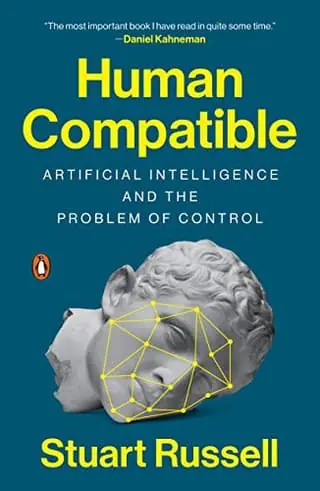
Human Compatible summary
by Stuart Russell · 2019 · 7 key ideas · 18-minute read
AI built to pursue fixed objectives is a recipe for disaster; machines should instead be built to serve human preferences they are humble enough to be unsure about.
Why read it
For readers who want a leading AI researcher's diagnosis of what's wrong with how AI is built — and a concrete, hopeful proposal to fix it.
Human Compatible in brief
Russell argues that success in AI could be the biggest event in human history — and that the way the field defines success is dangerously flawed. Since its beginnings, AI has followed a 'standard model': humans give a machine a fixed objective, and the machine optimises it. That works for chess, but in the real world we can never specify objectives completely and correctly.
He makes the case that the risk is real and not premature. Gorillas' future now depends on human choices; we should be wary of creating something that puts us in the same position. Breakthroughs can arrive unpredictably fast, and early warning signs, such as social media algorithms that reshape their users, are already here.
His alternative rests on three principles. A machine's only objective should be to realise human preferences; it should be initially uncertain about what those preferences are; and it should learn about them by observing human behaviour. A machine built this way has a reason to ask permission, accept correction and even allow itself to be switched off.
Russell doesn't pretend this is easy. Humans are many, inconsistent and sometimes nasty, and our preferences change. He also covers misuse — surveillance, autonomous weapons, job loss — and the quieter danger of humans becoming enfeebled by relying on machines for everything. His tone is urgent but optimistic: the problem is hard, but it's an engineering and research problem we can work on now.
The 7 key ideas
1. The gorilla problem
'Too early to worry' is a prediction, not a plan.
2. The standard model and King Midas
Be careful what you optimise for — you'll get it.
3. Social media: an early warning
An engagement machine can serve you best by changing you.
4. Three principles for beneficial machines
Certainty makes machines deaf; doubt makes them listen.
5. Why a humble robot lets you switch it off
You can't fetch the coffee if you're dead — unless you're humble.
6. Learning what people want is messy
Actions are evidence of what we want — not the whole truth.
7. Misuse and enfeeblement
Use the machine; don't forget how the world works.
Read the full guide in Kinquire. Every idea with a real example, a diagram and one thing to try today, plus a quick quiz so it sticks. Free to start.
Read Human CompatibleKey takeaways
- When setting goals, list what must not be sacrificed to reach them.
- Treat engagement-optimised feeds as systems that may be shaping you.
- In helping others, check what they want before acting confidently.
- Value humility as a safety feature, in machines and in people.
- Keep core skills alive rather than outsourcing them entirely.
Our take
Human Compatible is the clearest statement of the AI control problem by someone who helped build the field, and its key move — making uncertainty about objectives a safety feature — is genuinely constructive. It's also readable, with sharp analogies. Its limits: the proposal is a research direction, and the hard parts (aggregating preferences, handling irrational and nasty humans) remain open. Some critics see its timelines as speculative; others think it underplays corporate incentives. Since 2019, preference-learning methods have become central to building chatbots, giving the book's ideas new practical relevance.
About Stuart Russell
Stuart Russell is a professor of computer science at the University of California, Berkeley. He co-wrote, with Peter Norvig, Artificial Intelligence: A Modern Approach, the field's standard textbook.
If you liked this
- Superintelligence by Nick Bostrom
- The Alignment Problem by Brian Christian
- Life 3.0 by Max Tegmark
- Homo Deus by Yuval Noah Harari
- The Coming Wave by Mustafa Suleyman with Michael Bhaskar
- Chip War by Chris Miller