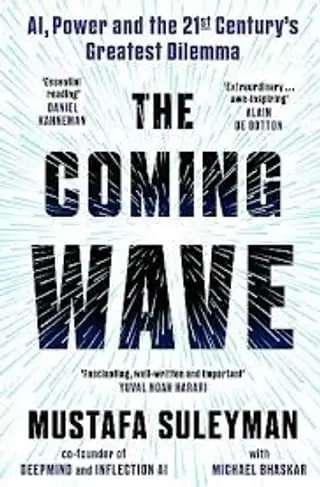
The Coming Wave summary
by Mustafa Suleyman with Michael Bhaskar · 2023 · 7 key ideas · 18-minute read
AI and synthetic biology are a wave of technology that will spread everywhere; containing it is close to impossible, yet humanity's future depends on finding a way.
Why read it
An insider's warning from a co-founder of DeepMind, for anyone who wants to understand why powerful technology is so hard to control and what a realistic response might look like.
The Coming Wave in brief
Suleyman frames history as a series of technology waves. General-purpose technologies — fire, writing, engines, electricity, computers — don't stay in labs. They get cheaper, easier to use and spread everywhere, reshaping society in ways their inventors never planned. The default outcome of any powerful technology is proliferation.
The next wave, he argues, is built on two cores: artificial intelligence and synthetic biology, surrounded by robotics, quantum computing and new energy sources. This wave has four features that make it unusually hard to control: asymmetric power, hyper-fast evolution, use for almost any purpose, and growing autonomy.
That creates the containment problem. Technologies have almost never been successfully held back, and powerful incentives — national rivalry, open science, profit, ego and real global needs — push this one forward. Meanwhile, nation states, already strained, face new pressures as tools of great power spread to small groups while also enabling unprecedented surveillance.
The result is a dilemma. Too little control risks catastrophe; too much risks a surveillance dystopia. Suleyman argues for a narrow path between them and offers ten overlapping steps, from technical safety research and audits to choke points, treaties and public movements. He admits containment looks impossible — and insists it must be possible anyway.
The 7 key ideas
1. Technology wants to spread
Useful technology doesn't trickle down — it floods out.
2. AI and biology at the core
Judge AI by what it can do, not whether it 'thinks'.
3. Four features that make it hard to contain
Same tool, any purpose, anyone, at speed.
4. The containment problem and pessimism aversion
Looking away from the downside doesn't make it smaller.
5. Incentives that push the wave forward
Don't fight the river; redirect the currents feeding it.
6. The great dilemma
Between catastrophe and control lies a narrow road — walk it deliberately.
7. Ten steps toward containment
No silver bullet — just many layers, pulling together.
Read the full guide in Kinquire. Every idea with a real example, a diagram and one thing to try today, plus a quick quiz so it sticks. Free to start.
Read The Coming WaveKey takeaways
- Assume useful technologies will spread; plan for when everyone has them.
- Watch for pessimism aversion in yourself and in meetings.
- Map the incentives behind a problem before trying to fix it.
- Look for choke points where small actions have outsized effect.
- Seek the narrow path between doing nothing and controlling everything.
Our take
The Coming Wave is valuable because it comes from someone who built frontier AI and still argues the risks are serious; its frameworks — the four features, pessimism aversion, the narrow path — are clear and memorable. Critics point to a tension: the author leads a major AI effort while warning about the race. The ten steps are broad and sometimes vague, and some historians think he understates past successes at restraining technology. Since 2023, the rise of AI agents, tighter chip controls and new safety institutes have made the book feel timely rather than alarmist.
About Mustafa Suleyman with Michael Bhaskar
Mustafa Suleyman co-founded the AI company DeepMind and later Inflection AI; in 2024 he became CEO of Microsoft AI. Michael Bhaskar is a British writer and publisher.
If you liked this
- Superintelligence by Nick Bostrom
- Chip War by Chris Miller
- Life 3.0 by Max Tegmark
- Homo Deus by Yuval Noah Harari
- Human Compatible by Stuart Russell
- The Innovators by Walter Isaacson