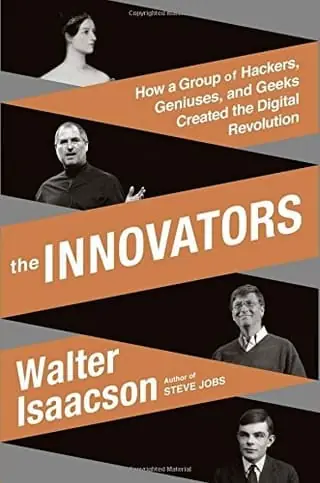
The Innovators summary
by Walter Isaacson · 2014 · 7 key ideas · 17-minute read
The digital revolution wasn't the work of lone geniuses but of collaborative teams, pairs and networks that joined science with imagination.
Why read it
For anyone curious about how computers and the internet really came to be — and for anyone who wants practical lessons on how innovation happens in teams.
The Innovators in brief
Isaacson tells the story of the digital age from Ada Lovelace in the 1840s to Google and Wikipedia, covering the computer, the transistor, the microchip, video games, the internet, the personal computer, software and the web. Instead of a single hero, the book is a group portrait.
His central argument is that innovation is collaborative. Breakthroughs came from teams that mixed theorists and tinkerers, from creative pairs who complemented each other, and from organisations that blended visionaries with disciplined managers. Brilliant individuals who worked alone often had good ideas that went nowhere.
He also highlights the ecosystem that made it possible: government funding, university research and private enterprise working together, along with a counterculture that saw computers as tools for personal freedom. Along the way he restores overlooked figures — including the women who programmed early computers — to the story.
A recurring theme is the connection between the humanities and technology. Lovelace called it 'poetical science', and Isaacson argues that the most creative innovators stood where art and engineering meet. He ends by suggesting that the most fruitful path has been machines augmenting human intelligence rather than replacing it.
The 7 key ideas
1. Poetical science
Rigour builds the machine; imagination sees its future.
2. Innovation is a team sport
Ideas are solo; innovations are team efforts.
3. Vision without execution goes nowhere
An idea nobody builds is just a daydream.
4. Government, universities and business together
No single leg built the digital age.
5. Software matters as much as hardware
The machine is nothing until someone tells it what to do.
6. Counterculture meets computing
Freedom and profit both built the digital world.
7. Augment humans, don't replace them
Best results: human judgement plus machine speed.
Read the full guide in Kinquire. Every idea with a real example, a diagram and one thing to try today, plus a quick quiz so it sticks. Free to start.
Read The InnovatorsKey takeaways
- Build teams that combine visionaries, builders and managers.
- Pair technical work with inspiration from the arts.
- Connect your ideas to people who can execute them.
- Credit the behind-the-scenes contributors who make things work.
- Use technology to augment your judgement, not replace it.
Our take
The Innovators is a lively, well-sourced history that makes a persuasive case against the lone-genius myth and gives overdue credit to figures like Lovelace and the ENIAC programmers. Its breadth means many stories are brief, and it focuses heavily on American figures, with less on European or Asian contributions. Some historians find its lessons a little tidy for a messy history. Its closing claim that augmentation beats AI looks less secure after the rapid progress of large language models — though the collaborative picture of innovation has held up well.
About Walter Isaacson
Walter Isaacson is an American journalist and biographer who has written lives of Steve Jobs, Albert Einstein and Benjamin Franklin. He was previously chairman of CNN and managing editor of Time.
If you liked this
- Steve Jobs by Walter Isaacson
- Chip War by Chris Miller
- Co-Intelligence by Ethan Mollick
- The Second Machine Age by Erik Brynjolfsson and Andrew McAfee
- Homo Deus by Yuval Noah Harari
- Life 3.0 by Max Tegmark