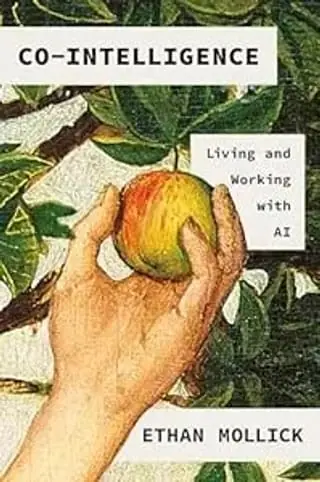
Co-Intelligence summary
by Ethan Mollick · 2024 · 7 key ideas · 18-minute read
Generative AI is a strange, powerful co-worker; the way to thrive is to use it constantly, stay in charge, and learn where it's brilliant and where it fails.
Why read it
A practical, evidence-based guide for anyone who wants to work, learn and create alongside AI right now — written by a researcher who uses it daily and studies its effects.
Co-Intelligence in brief
Mollick argues that large language models are a general-purpose technology unlike any before: not quite software, not quite people, but something alien that can write, reason, create and make things up. He describes his own 'three sleepless nights' after first using ChatGPT, realising how much would change.
He offers four rules for working with AI: always invite it to the table; be the human in the loop; treat it like a person, but tell it what kind of person it is; and assume this is the worst AI you'll ever use. The rules are about experimenting widely while keeping your judgement switched on.
Drawing on his research, including a large study with consultants at Boston Consulting Group, Mollick introduces the 'jagged frontier': AI is excellent at some tasks and surprisingly bad at others that seem similar. Workers who used AI inside the frontier performed much better; outside it, they made more mistakes.
He then explores AI as a creative partner, co-worker, tutor and coach, describing two working styles — centaurs who divide tasks and cyborgs who blend them — and the risk that AI erodes the apprenticeships through which experts are made. He ends with four possible futures, from AI plateauing to the arrival of something like a machine god, insisting that how we use AI is still our choice.
The 7 key ideas
1. Four rules for working with AI
Invite it in, stay in charge, give it a role, expect better.
2. The jagged frontier
Inside the frontier, AI lifts you; outside, it trips you.
3. Centaurs and cyborgs
Divide like a centaur, or blend like a cyborg — but don't abdicate.
4. Give AI a persona — but don't be fooled
Give it a role, but keep your own judgement.
5. Just me, delegated, automated
Keep what matters, delegate with checks, automate the drudgery.
6. Tutor, coach — and the apprenticeship problem
Let AI coach you, not carry you.
7. Four possible futures
Plan for several futures; bet your career on none.
Read the full guide in Kinquire. Every idea with a real example, a diagram and one thing to try today, plus a quick quiz so it sticks. Free to start.
Read Co-IntelligenceKey takeaways
- Try AI on every task you can to learn where it helps.
- Always check AI's work, especially outside its frontier.
- Give AI a role, an audience and a goal in your prompts.
- Sort tasks into Just Me, Delegated and Automated.
- Use AI as a coach that builds your skills, not a crutch.
Our take
Co-Intelligence is one of the most practical books on generative AI: grounded in research, clear about limits, and full of usable techniques like the four rules and the jagged frontier. Its focus on knowledge work means it says less about AI's effects on manual labour, inequality or the environment. Some readers find it too upbeat about workplace adoption, and specific tool advice dates quickly. But its core habits — experiment constantly, stay the human in the loop, map the frontier for your own work — have aged well as models improve.
About Ethan Mollick
Ethan Mollick is an associate professor at the Wharton School of the University of Pennsylvania, where he studies innovation and entrepreneurship. He writes the widely read newsletter One Useful Thing.
If you liked this
- The Second Machine Age by Erik Brynjolfsson and Andrew McAfee
- Human Compatible by Stuart Russell
- The Innovators by Walter Isaacson
- AI Superpowers by Kai-Fu Lee
- Homo Deus by Yuval Noah Harari
- Life 3.0 by Max Tegmark