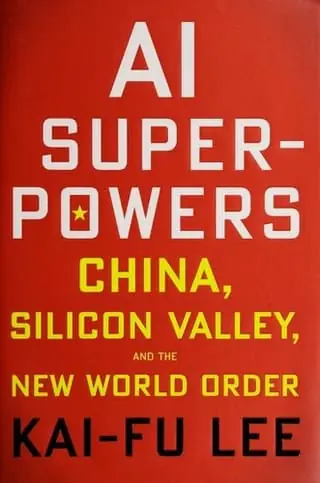
AI Superpowers summary
by Kai-Fu Lee · 2018 · 8 key ideas · 20-minute read
AI has moved from an age of discovery to an age of implementation, which favours China's data, entrepreneurs and state support — and will upend jobs everywhere unless we rethink work and care.
Why read it
For anyone who wants an insider's view of the US–China AI race and a humane take on how AI could reshape jobs, inequality and what we value in people.
AI Superpowers in brief
Lee argues that the deep-learning breakthrough of the 2000s and 2010s shifted AI from an age of discovery, where a few elite researchers made big leaps, to an age of implementation, where advantage goes to whoever applies existing techniques fastest. That shift, he says, plays to China's strengths: abundant data, fierce entrepreneurs and a supportive government.
He tells how Chinese tech grew from copycats into gladiators. Founders learned in a brutal domestic market, built 'heavy' businesses that run everything from payments to delivery, and created a mobile-first ecosystem generating more real-world data than anywhere else. After AlphaGo beat top human Go players, China's government made AI a national priority.
Lee describes four waves of AI — internet, business, perception and autonomous — and predicts the US and China will dominate them, capturing most of the wealth. Many jobs, especially routine ones, will be displaced, and developing countries may lose the ladder of cheap manufacturing that lifted others out of poverty.
The final part turns personal. Lee recounts his diagnosis with stage IV lymphoma and how it made him question a life devoted to work. He concludes that what AI can't replace is love and human connection, and proposes a 'social investment stipend' to reward care, community service and education rather than a simple universal basic income.
The 8 key ideas
1. From discovery to implementation
Inventors open the door; implementers walk through it.
2. China's Sputnik moment
Shock can turn a curiosity into a national mission.
3. Copycats to gladiators
Copying is a classroom; competition is the exam.
4. Data is the new oil — and China has more
The more life goes through an app, the more data the app holds.
5. Four waves of AI
Online, business, senses, action — AI moves outward in waves.
6. Which jobs are at risk
Routine and alone is risky; creative and caring is safe.
7. A new world order of inequality
The real AI crisis is economic, not robotic.
8. Love is what machines can't give
Let machines optimise; let humans love.
Read the full guide in Kinquire. Every idea with a real example, a diagram and one thing to try today, plus a quick quiz so it sticks. Free to start.
Read AI SuperpowersKey takeaways
- Focus on implementing proven tools, not just chasing new ones.
- Assess your job on routine versus creative, asocial versus social.
- Build skills in care, connection and strategy.
- Notice how much of your offline life becomes data.
- Make time for the people you love — the one thing machines can't replace.
Our take
AI Superpowers offers rare insider knowledge of China's tech scene and a thoughtful, personal vision of a humane AI future. Its framing of a two-power race was influential, and its job-risk charts are practical. But it underplays the role of government protectionism and surveillance in China's success, and the 'age of implementation' thesis was challenged by large language models, a new discovery-era leap from US labs. Its optimism about Chinese data advantages has also been complicated by chip export controls — even as Chinese labs have since shown they can compete.
About Kai-Fu Lee
Kai-Fu Lee is a Taiwanese-born computer scientist and investor who worked at Apple and Microsoft, led Google China, and founded the venture firm Sinovation Ventures in Beijing.
If you liked this
- Chip War by Chris Miller
- The Second Machine Age by Erik Brynjolfsson and Andrew McAfee
- The Coming Wave by Mustafa Suleyman with Michael Bhaskar
- Homo Deus by Yuval Noah Harari
- Life 3.0 by Max Tegmark
- Superintelligence by Nick Bostrom