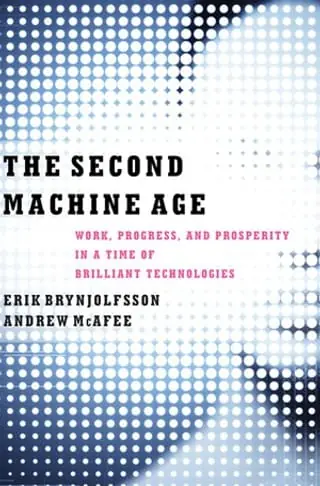
The Second Machine Age summary
by Erik Brynjolfsson and Andrew McAfee · 2014 · 7 key ideas · 17-minute read
Digital technologies are doing for mental work what the steam engine did for muscle power — creating enormous bounty, but also a widening spread between winners and losers.
Why read it
For anyone who wants a clear economic framework for how computers and AI reshape work, wages and growth, and what individuals and governments can do about it.
The Second Machine Age in brief
The authors argue that humanity is entering a second machine age. The first, launched by the steam engine, overcame the limits of muscle power and bent the curve of human history upward. The second, driven by digital technologies, is overcoming limits of mental power — and its effects will be just as profound.
Three forces drive it. Computing power is growing exponentially; nearly everything is becoming digital, so it can be copied and shared at almost zero cost; and innovation is increasingly combinatorial, recombining existing building blocks into new products. Together, they explain sudden leaps like driverless cars and computers that win quiz shows.
The upside is bounty: more variety, better quality and lower prices, much of it free and invisible in GDP statistics. The downside is spread: rising inequality as rewards flow to the highly skilled, to owners of capital and to superstars, while many ordinary workers see wages stagnate.
The authors are optimists, not utopians. They argue people should learn to race with machines rather than against them, focusing on ideas, big-picture pattern recognition and complex communication. They propose policies — better education, support for start-ups, immigration of talent, investment in infrastructure and research — and, for the long term, a negative income tax to support people while preserving the value of work.
The 7 key ideas
1. Machines for the mind
First we multiplied muscle; now we're multiplying mind.
2. Exponential, digital, combinatorial
Faster, copyable, recombinable — that's the digital engine.
3. The second half of the chessboard
Exponentials are boring — until the second half of the board.
4. The bounty we don't measure
Not everything that counts is counted.
5. Bounty and spread
A bigger pie doesn't mean a bigger slice for you.
6. Race with the machines
Don't race against the machine — race with it.
7. Policies for a machine age
Work saves us from boredom, vice and need.
Read the full guide in Kinquire. Every idea with a real example, a diagram and one thing to try today, plus a quick quiz so it sticks. Free to start.
Read The Second Machine AgeKey takeaways
- Expect exponential trends to look slow before they look sudden.
- Combine existing building blocks to create new ideas.
- Count the free digital value in your life, not just what you pay for.
- Position yourself on the winning side of skills, capital and standout niches.
- Race with machines by focusing on ideas, judgement and communication.
Our take
The Second Machine Age is clear, optimistic and influential, offering a simple framework — exponential, digital, combinatorial; bounty and spread — that still helps people think about technology and work. Its predictions about driverless cars proved too early, and the productivity boom it anticipated largely failed to appear in the 2010s, a puzzle the authors acknowledged. Its policy proposals are sensible but conventional. The rise of generative AI since 2022 has given the book's core questions — how to share the bounty and limit the spread — renewed urgency.
About Erik Brynjolfsson and Andrew McAfee
Erik Brynjolfsson and Andrew McAfee are economists of technology who worked together at MIT; Brynjolfsson later moved to Stanford. Their earlier book together was Race Against the Machine.
If you liked this
- The Innovators by Walter Isaacson
- AI Superpowers by Kai-Fu Lee
- Homo Deus by Yuval Noah Harari
- Life 3.0 by Max Tegmark
- Superintelligence by Nick Bostrom
- Human Compatible by Stuart Russell