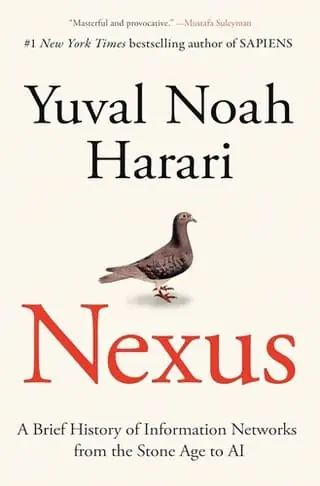
Nexus summary
by Yuval Noah Harari · 2024 · 8 key ideas · 20-minute read
Information networks connect people more than they reveal truth, and AI is the first technology that can act within those networks on its own — so we need strong self-correcting institutions.
Why read it
For anyone wondering why more information hasn't made us wiser, how democracies and dictatorships differ as information systems, and what AI means for both.
Nexus in brief
Harari opens by rejecting what he calls the naive view of information: that more information leads to more truth, and more truth to wisdom and power. History shows otherwise. Information's main job is to connect people, and the stories and documents that bind large networks are often not true. They can produce order without truth.
Tracing information networks from the Stone Age to today, he shows how stories created shared identities and how written documents created bureaucracy. Both helped humans cooperate on a vast scale, but both were prone to error. The key question is whether a network has self-correcting mechanisms that let it find and fix its mistakes.
He uses this lens to compare democracy and totalitarianism. Democracies are distributed networks with strong self-correction — courts, a free press, elections. Totalitarian regimes centralise information and suppress correction, so their errors pile up unseen. New information technologies, from the printing press to radio, have repeatedly reshaped which systems could work.
AI, he argues, is different from any previous technology because it is not a tool but an agent: it can make decisions and create new ideas by itself. Computers are joining our networks as active members that never sleep, may be misaligned with our goals, and may be impossible to understand. He warns of total surveillance, algorithmic chaos and a 'silicon curtain' dividing the world, and calls for institutions that can catch AI's mistakes before they become catastrophic.
The 8 key ideas
1. Information connects before it informs
Information connects first; truth is optional.
2. Stories and documents
Stories make us belong; documents decide what we're allowed.
3. Fallible networks need self-correction
Not 'Who is infallible?' but 'How do we catch mistakes?'
4. Democracy and dictatorship as networks
Freedom is a feedback system.
5. AI is an agent, not a tool
The printing press copied; AI decides.
6. The alignment problem, historically
Win the metric, lose the mission.
7. Always on, never understood
A network that never sleeps needs humans who do.
8. The silicon curtain
Curtains of code can divide as surely as walls.
Read the full guide in Kinquire. Every idea with a real example, a diagram and one thing to try today, plus a quick quiz so it sticks. Free to start.
Read NexusKey takeaways
- Don't assume more information means more truth; check how it connects people.
- Value institutions that expose and correct mistakes.
- Notice which decisions algorithms are making for you.
- Ask what bigger goal any metric is supposed to serve.
- Protect time and space away from always-on networks.
Our take
Nexus offers a fresh frame — history as the story of information networks — and makes a strong case that more information doesn't mean more truth. Its emphasis on self-correcting institutions is wise and timely. But it's long, sometimes repetitive, and historians find some of its sweeping claims simplified. Its account of AI mixes well-documented harms with speculative warnings, and some readers feel the solutions are thin. Still, as AI systems increasingly act on their own online, its central point — that AI is an agent, not a tool — looks more relevant each year.
About Yuval Noah Harari
Yuval Noah Harari is an Israeli historian at the Hebrew University of Jerusalem and the author of Sapiens and Homo Deus.
If you liked this
- Sapiens by Yuval Noah Harari
- Homo Deus by Yuval Noah Harari
- The Age of Surveillance Capitalism by Shoshana Zuboff
- The Alignment Problem by Brian Christian
- Life 3.0 by Max Tegmark
- Superintelligence by Nick Bostrom