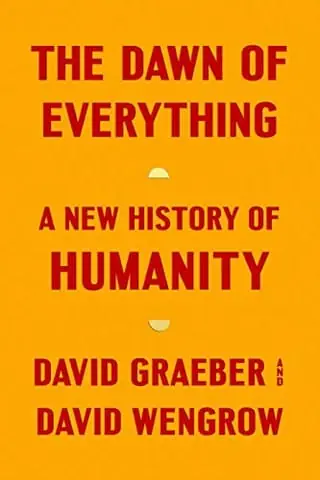
The Dawn of Everything summary
by David Graeber and David Wengrow · 2021 · 7 key ideas · 17-minute read
An anthropologist and an archaeologist argue that early humans consciously experimented with many forms of society — so the big question isn't how inequality began, but how we got stuck.
Why read it
It challenges the standard story from egalitarian foragers to farming to states, and it will change how you think about what's 'natural' or inevitable in politics. Read it critically: it's provocative and contested.
The Dawn of Everything in brief
Graeber and Wengrow attack a familiar story: that humans lived for most of history in small, equal bands, until farming led to surplus, cities, kings and inequality. Whether told in Rousseau's version (we lost innocence) or Hobbes's (we escaped brutality), they argue it is a myth that makes our current arrangements seem inevitable.
They suggest the story itself was born partly as a reaction to Indigenous critics of European society, such as the Wendat statesman Kandiaronk, whose arguments about freedom circulated in Enlightenment Europe.
Drawing on archaeology and ethnography, they argue that early humans were self-conscious political thinkers. Some societies changed their structure with the seasons; foragers built monuments; farming spread slowly and was often abandoned; and some early cities seem to have flourished for centuries without kings or obvious rulers.
The authors propose three basic freedoms — to move away, to disobey and to reorganise society — and three sources of domination: control of violence, control of information and charismatic competition. The real question, they conclude, is how humans lost the freedom to experiment and got stuck in one form of society. They leave that question open.
The 7 key ideas
1. Ditch the Rousseau-or-Hobbes story
The past was full of choices, not stages.
2. The Indigenous critique
Sometimes the sharpest critique of your world comes from outside it.
3. Societies that changed with the seasons
If you can switch hierarchy off, it isn't destiny.
4. Farming wasn't a revolution
Most revolutions are slow experiments in disguise.
5. Cities without kings
Scale doesn't require a king.
6. Three freedoms we lost
Freedom is the power to leave, refuse and rebuild.
7. Defined against the neighbours
Some of who we are is just who they aren't.
Read the full guide in Kinquire. Every idea with a real example, a diagram and one thing to try today, plus a quick quiz so it sticks. Free to start.
Read The Dawn of EverythingKey takeaways
- Question claims that any social arrangement is 'natural' or inevitable.
- Seek outside critiques of your own society or organisation.
- Experiment with switchable structures in your teams and routines.
- Protect your freedoms to leave, refuse and reorganise.
- Check which of your values exist mainly in opposition to others.
Our take
The Dawn of Everything is energetic, learned and liberating: it makes a strong case that early societies were far more varied and politically self-aware than popular histories suggest, and much of its archaeology reflects current research. Critics, including reviewers such as the philosopher Kwame Anthony Appiah, argue it sometimes chooses the most egalitarian reading of ambiguous evidence, caricatures the authors it attacks, and relies heavily on Lahontan's literary version of Kandiaronk. Its central question — how we got stuck — is posed rather than answered. Read it as a powerful challenge to received wisdom, not a settled replacement.
About David Graeber and David Wengrow
David Graeber was an American anthropologist who taught at the London School of Economics and wrote Debt: The First 5,000 Years; he died in 2020, shortly after the book was completed. David Wengrow is a British archaeologist at University College London's Institute of Archaeology.
If you liked this
- Sapiens by Yuval Noah Harari
- Guns, Germs, and Steel by Jared Diamond
- The Silk Roads by Peter Frankopan
- SPQR by Mary Beard
- The Rise and Fall of the Third Reich by William L. Shirer
- 1776 by David McCullough