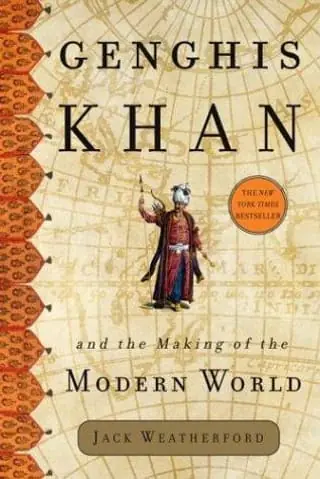
Genghis Khan and the Making of the Modern World summary
by Jack Weatherford · 2004 · 7 key ideas · 18-minute read
An outcast from the Mongolian steppe built the largest contiguous land empire in history — and, Weatherford argues, wired together the modern world.
Why read it
A vivid reappraisal of a figure usually reduced to 'barbarian'. It's full of lessons on organisation, meritocracy and adaptability — while also requiring a critical eye on its more admiring claims.
Genghis Khan and the Making of the Modern World in brief
Weatherford tells the life of Temujin, born around 1162 on the Mongolian steppe. After his father was poisoned, his family was abandoned by their clan and survived on the edge of starvation. Through alliances, ruthlessness and an unusual knack for winning loyalty, Temujin united the steppe tribes and in 1206 was proclaimed Genghis Khan.
He then reorganised Mongol society: breaking up old tribal loyalties, promoting people on merit and loyalty, and building a disciplined army organised in units of ten. With fast cavalry, intelligence networks and borrowed siege technology, the Mongols conquered northern China, Central Asia and Persia, using terror to encourage surrender.
After Genghis's death in 1227, his sons and grandsons extended the empire from Korea to eastern Europe. Weatherford argues the Mongols, though brutal in conquest, ruled with notable religious tolerance, protected trade, built a relay communication system and promoted the exchange of goods, technology and ideas across Eurasia.
The empire fractured in the 14th century, hastened by plague. But Weatherford claims its legacy — a connected Eurasia, global trade and the circulation of knowledge — helped lay the foundations of the modern world, including the European Renaissance. That last claim, especially, remains controversial.
The 7 key ideas
1. Forged on the margins
Loyalty earned in crisis outlasts loyalty inherited.
2. Merit over kinship
Break the old loyalties; build new ones around merit.
3. Absorb the best of everyone
Borrow brilliance; don't reinvent it.
4. Terror as a strategy
Reputation arrives before you do — for better or worse.
5. Tolerance as policy
Diversity managed well becomes strength.
6. Trade was the point
Protect the routes and the riches follow.
7. Wiring the world together
Every network carries both ideas and infections.
Read the full guide in Kinquire. Every idea with a real example, a diagram and one thing to try today, plus a quick quiz so it sticks. Free to start.
Read Genghis Khan and the Making of the Modern WorldKey takeaways
- Reward loyalty and performance over background.
- Mix teams to break down old divisions.
- Borrow expertise from outsiders instead of reinventing it.
- Protect the routes — suppliers, partners, platforms — your success depends on.
- Remember that your reputation shapes others' choices before you act.
Our take
Weatherford's book was a valuable corrective to centuries of portraying the Mongols as mindless barbarians, and it brought The Secret History and Mongol perspectives to a wide audience. His explanations of Mongol organisation, tolerance and trade are vivid and largely grounded. But many historians find the book too admiring: it can downplay the scale of killing and destruction, and its claims that the Mongols helped create the Renaissance and modern institutions go beyond the evidence. Read it as an energetic, partly revisionist account, ideally alongside more cautious scholarly histories.
About Jack Weatherford
Jack Weatherford is an American anthropologist who taught for many years at Macalester College in Minnesota. He researched the book through extensive travel in Mongolia and drew heavily on The Secret History of the Mongols, a 13th-century Mongol chronicle.
If you liked this
- The Silk Roads by Peter Frankopan
- Guns, Germs, and Steel by Jared Diamond
- Sapiens by Yuval Noah Harari
- SPQR by Mary Beard
- The Rise and Fall of the Third Reich by William L. Shirer
- 1776 by David McCullough