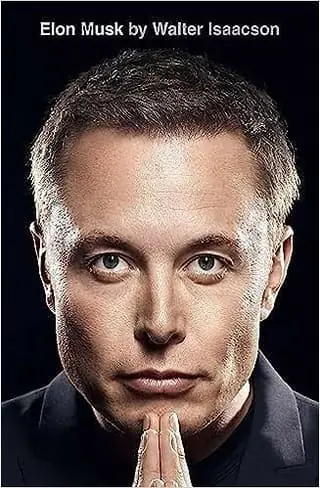
Elon Musk summary
by Walter Isaacson · 2023 · 7 key ideas · 18-minute read
A close-up portrait of a risk-addicted engineer whose drive, physics-first thinking and 'demon mode' built SpaceX and Tesla — and caused chaos.
Why read it
For anyone curious about how audacious engineering companies are run, and about the uncomfortable link between extraordinary drive and harmful behaviour.
Elon Musk in brief
Musk grew up in Pretoria, South Africa, a socially awkward, bookish boy who was badly bullied at school and emotionally battered by his father, Errol. Isaacson treats this childhood as the key to the man: a high tolerance for pain, a craving for drama and risk, and a mission-driven seriousness that rarely relaxes.
He left for Canada at 17, studied in the United States, and co-founded Zip2 and then X.com, which merged into PayPal. Ousted as PayPal's CEO, he still made a fortune from its sale to eBay and poured it into two long shots: SpaceX, to make humanity multiplanetary, and Tesla, to speed the shift to electric cars.
In 2008 both companies nearly died. SpaceX's first three rockets failed and Tesla was running out of cash. A fourth launch succeeded, NASA awarded a contract, and a last-minute Tesla funding round closed at Christmas. That near-death experience cemented Musk's appetite for betting everything.
The book follows his operating style in detail: questioning every requirement, deleting parts, living on factory floors during production 'surges' and pushing teams with maniacal urgency. It covers the Model 3 production hell, Starlink, the steel Starship, and the 2022 purchase of Twitter, which he transformed abruptly.
Isaacson portrays a man of mood swings — visionary one hour, cruel the next — whose partner Grimes called his darkest state 'demon mode'. The book's central question is whether the brilliance and the damage can be separated, or whether they come as a package.
The 7 key ideas
1. Forged by a hard childhood
Your engine and your shadow often share one source.
2. The algorithm
Don't optimise what shouldn't exist.
3. Reason from physics
Physics is the law; everything else is advice.
4. Maniacal urgency
Speed is a feature — but so is safety.
5. Bet the house
Know your stop-loss before you go all-in.
6. The factory is the product
If you design it, go watch it being built.
7. Demon mode and its price
Intensity is fuel; cruelty is a leak.
Read the full guide in Kinquire. Every idea with a real example, a diagram and one thing to try today, plus a quick quiz so it sticks. Free to start.
Read Elon MuskKey takeaways
- Question every requirement and tie it to a real person.
- Delete before you optimise, and optimise before you automate.
- Compare a thing's price to its raw materials to spot waste.
- Use speed to learn faster, but keep safety non-negotiable.
- Set limits on risk before you bet big.
- Notice when intensity turns into cruelty — and stop.
Our take
The book's strength is access: Isaacson was in meetings, factories and late-night sessions, giving vivid detail on how Musk works. It is candid about his flaws. But some reviewers felt Isaacson was too close to his subject and too willing to frame cruelty as the price of genius. The narrative is episodic, with many short chapters, and offers less analysis of the business, labour or political consequences of Musk's choices. One passage on Starlink in Ukraine was publicly clarified by Isaacson after publication. Read it as a vivid portrait, not a final verdict.
About Walter Isaacson
Walter Isaacson is the author of bestselling biographies of Steve Jobs, Einstein and Leonardo da Vinci, and a former head of CNN. He shadowed Musk for about two years to write this book.
If you liked this
- Steve Jobs by Walter Isaacson
- The Lean Startup by Eric Ries
- Sapiens by Yuval Noah Harari
- Guns, Germs, and Steel by Jared Diamond
- The Silk Roads by Peter Frankopan
- SPQR by Mary Beard