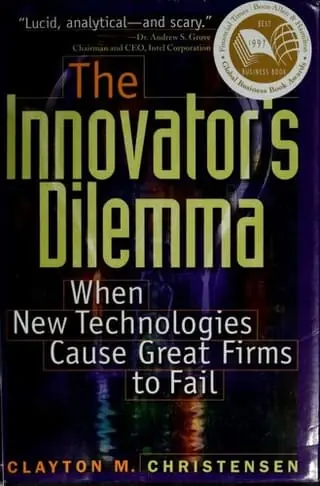
The Innovator's Dilemma summary
by Clayton M. Christensen · 1997 · 7 key ideas · 18-minute read
Great companies often fail not because they are badly run but because they are well run: doing exactly what their best customers want blinds them to cheaper, simpler technologies that later take over.
Why read it
For anyone leading a successful product or company — or trying to topple one. It explains why market leaders keep losing to scrappy newcomers, and what an incumbent can actually do about it.
The Innovator's Dilemma in brief
Christensen starts with a puzzle: why do well-managed, leading companies so often lose their position when certain kinds of technology arrive? His answer comes mainly from a detailed study of the computer disk-drive industry, where generations of leaders were overthrown again and again, supported by cases from excavators, steel, retailing and motorcycles.
He distinguishes sustaining technologies, which improve products along the lines existing customers value, from disruptive technologies, which at first perform worse on those measures but are cheaper, simpler, smaller or more convenient. Incumbents nearly always win the sustaining battles. They usually lose the disruptive ones.
The reason is not stupidity. Listening to your best customers, investing in the highest margins and pursuing large markets are all sound practices — and all of them steer resources away from disruptive products, whose early markets are small, unprofitable-looking and unknown. Meanwhile technology tends to improve faster than customers need, so the ‘worse’ product eventually becomes good enough and takes over.
Christensen’s prescription is to give a disruptive project to an independent organization small enough to get excited about small wins, with its own cost structure and customers, and to plan for learning rather than precise forecasts, because markets that don’t yet exist can’t be analysed.
The 7 key ideas
1. Good management can be the trap
Doing everything right can still be the wrong move.
2. Sustaining versus disruptive
It’s not how hard the technology is — it’s whether it fits the model.
3. Performance overshoots what customers need
Good enough plus cheaper beats better.
4. Customers and investors control resources
Follow the money to see who really decides.
5. Small markets don’t solve big companies’ growth needs
Today’s tiny market is tomorrow’s mainstream.
6. Capabilities are also disabilities
Your strengths are built for yesterday’s job.
7. Spin it out and plan to learn
Can’t forecast it? Design to learn it.
Read the full guide in Kinquire. Every idea with a real example, a diagram and one thing to try today, plus a quick quiz so it sticks. Free to start.
Read The Innovator's DilemmaKey takeaways
- Watch for cheaper, simpler alternatives your best customers dismiss.
- Ask whether your product has overshot what most customers need.
- Give new disruptive projects their own small team, budget and customers.
- Treat forecasts for new markets as guesses and design for fast learning.
- Notice where your processes and priorities quietly block new ideas.
Our take
The Innovator’s Dilemma reshaped how leaders think about technology and competition, and its central insight — that rational resource allocation can doom incumbents — is genuinely powerful. But ‘disruption’ became a buzzword stretched to cover almost any change. Historian Jill Lepore argued in a 2014 New Yorker essay that the case evidence was selective, and others have found the theory better at explaining the past than predicting the future; Christensen himself famously doubted the iPhone. Read it as a sharp lens on one important pattern, not a theory of everything.
About Clayton M. Christensen
Clayton Christensen was a professor at Harvard Business School whose theory of disruptive innovation became one of the most influential ideas in modern management. He died in 2020.
If you liked this
- Crossing the Chasm by Geoffrey A. Moore
- Good to Great by Jim Collins
- Built to Last by Jim Collins and Jerry I. Porras
- Blue Ocean Strategy by W. Chan Kim and Renée Mauborgne
- Good Strategy Bad Strategy by Richard Rumelt
- The Goal by Eliyahu M. Goldratt