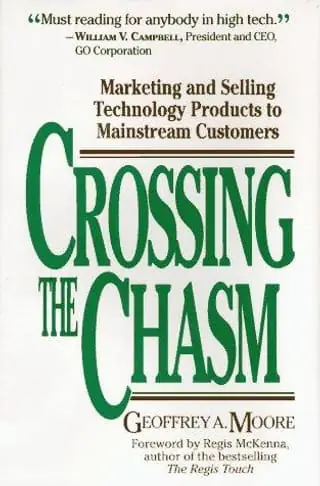
Crossing the Chasm summary
by Geoffrey A. Moore · 1991 · 8 key ideas · 21-minute read
New technologies stall in the gap between enthusiastic early adopters and cautious mainstream buyers, and the way across is to dominate one narrow niche first.
Why read it
For founders, product managers and marketers selling something new, especially to businesses. It explains why early success often collapses and what to do about it.
Crossing the Chasm in brief
Moore builds on the technology adoption life cycle, a model of how new products spread through groups: innovators, early adopters, early majority, late majority and laggards. Each group adopts for different reasons. Marketing usually treats the cycle as a smooth curve, moving from one group to the next.
His key insight is that the curve isn't smooth. There is a deep gap, the chasm, between the early adopters, who are visionaries wanting a breakthrough, and the early majority, pragmatists who want a proven, low-risk improvement. Many companies that thrive with visionaries fall into this gap and never reach the mainstream.
To cross it, Moore borrows the image of the D-Day landings. Concentrate all your force on a single, narrow beachhead segment of pragmatic customers with a compelling reason to buy. Deliver the whole product they need, not just the core technology, and dominate that niche. Then use it as a base to move into neighbouring segments.
The rest of the book covers how to choose the target, define the competition and position the product, and launch with the right distribution and pricing. It was revised in 1999 and again in 2014 with updated examples, but the core model has stayed the same.
The 8 key ideas
1. The adoption life cycle
Same product, five different reasons to buy.
2. The chasm
What wins visionaries won't win pragmatists.
3. Pragmatists need pragmatists
Ten references in one niche beat one in ten.
4. The D-Day strategy
Win one beach before you invade the continent.
5. Choose by compelling reason to buy
Nice to have doesn't cross chasms. Must have does.
6. Deliver the whole product
They don't buy the drill. They buy the finished shelf.
7. Create the competition and position
If you can't name your competition, buyers can't place you.
8. Launch with direct sales and leader pricing
Pragmatists buy from leaders, and leaders don't discount.
Read the full guide in Kinquire. Every idea with a real example, a diagram and one thing to try today, plus a quick quiz so it sticks. Free to start.
Read Crossing the ChasmKey takeaways
- Identify whether your current customers are visionaries or pragmatists.
- Pick one narrow beachhead segment with an urgent reason to buy.
- Build a cluster of references within that segment before expanding.
- Map the whole product your customers need and fill the gaps with partners.
- Write a positioning statement that names a market alternative and a product alternative.
- Price as the leader of your niche, not as the cheapest option.
Our take
Crossing the Chasm has shaped how a generation of tech companies think about going to market; the visionary-pragmatist distinction and the beachhead strategy remain widely used. It works best for complex products sold to businesses. For consumer apps, freemium software and products that spread through networks, the chasm can look different or less sharp. Its methods for choosing a niche rely heavily on judgement and imagined scenarios. The model also simplifies buyers into neat categories. Despite this, its core advice, focus on one segment and give it a complete solution, has held up well across three editions.
About Geoffrey A. Moore
Geoffrey A. Moore is a consultant and author who has advised many technology companies. His later books include Inside the Tornado and Zone to Win.
If you liked this
- Zero to One by Peter Thiel with Blake Masters
- The Innovator's Dilemma by Clayton M. Christensen
- The Lean Startup by Eric Ries
- The Hard Thing About Hard Things by Ben Horowitz
- The E-Myth Revisited by Michael E. Gerber
- $100M Offers by Alex Hormozi