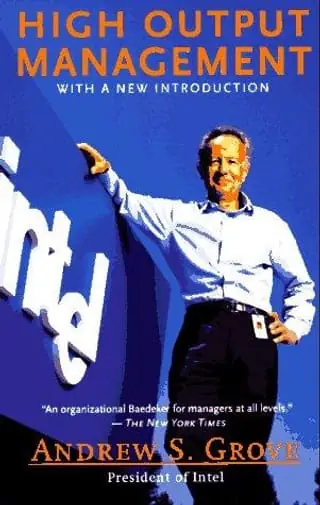
High Output Management summary
by Andrew S. Grove · 1983 · 7 key ideas · 18-minute read
Intel's legendary CEO treats management as production: a manager's output is the output of their team, and every activity should be judged by the leverage it creates.
Why read it
For new and experienced managers who want a practical, engineering-style manual rather than inspiration. Founders and tech leaders still pass it around as the best book on the day-to-day job of managing.
High Output Management in brief
Grove approaches management the way an engineer approaches a factory. He opens with a ‘breakfast factory’ — making eggs, toast and coffee to order — to show that any work, including knowledge work, can be understood as a production process with steps, bottlenecks, inventory and quality checks.
His key definition follows: a manager's output is the output of their own organisation plus the output of the neighbouring organisations they influence. So a manager's job isn't to be busy but to choose activities with high leverage — those that improve many people's output at once — through gathering information, making decisions, nudging others and acting as a role model.
The middle of the book covers the manager's tools: meetings (especially regular one-on-ones), decision-making, planning, and the objectives-and-key-results system Intel used. He also explains how to organise teams that must serve both specialist functions and business units at once, and why every structure involves a trade-off between responsiveness and economies of scale.
The final section is about people. Grove argues that if someone isn't performing, they either can't or won't, and the manager's two tools are training and motivation. He adapts his management style to each person's task-relevant maturity, and treats performance reviews and training as some of the highest-leverage things a manager does.
The 7 key ideas
1. Run work like a breakfast factory
Find the slowest step; catch errors while they're cheap.
2. Your output is your team's output
Judge your day by your team's results, not your activity.
3. Seek managerial leverage
Do the work that multiplies work.
4. One-on-ones belong to them
Their agenda, your questions, both of you learn.
5. Match your style to task-relevant maturity
Manage the task, not the person.
6. Can't or won't
Can't needs training; won't needs motivation.
7. Decide well, then fully commit
Argue freely, decide clearly, support fully.
Read the full guide in Kinquire. Every idea with a real example, a diagram and one thing to try today, plus a quick quiz so it sticks. Free to start.
Read High Output ManagementKey takeaways
- Measure your success by your team's output, not your own busyness.
- Move time toward high-leverage work: priorities, training and fast decisions.
- Hold regular one-on-ones where the other person sets the agenda.
- Adjust how closely you manage based on experience with the specific task.
- Diagnose performance problems as ‘can't’ or ‘won't’ before acting.
- Make decisions clearly and ask everyone to support them fully.
Our take
High Output Management is unusually concrete and still feels modern, which is why tech leaders keep recommending it. Its engineering lens is a strength — management becomes something you can analyse and improve — but also a limit: it says less about emotions, culture and creativity, and some examples reflect 1980s manufacturing. Its view of motivation leans on Maslow, which modern psychology treats more cautiously. Some readers find its approach to performance reviews and decision-making heavy for small teams. As a practical operating manual for managers, though, few books match it.
About Andrew S. Grove
Andrew S. Grove was a Hungarian-born engineer who escaped to the United States after the 1956 revolution. He was one of Intel's earliest employees and later its president and CEO.
If you liked this
- The Effective Executive by Peter F. Drucker
- Measure What Matters by John Doerr
- The Making of a Manager by Julie Zhuo
- The Hard Thing About Hard Things by Ben Horowitz
- Good to Great by Jim Collins
- Built to Last by Jim Collins and Jerry I. Porras