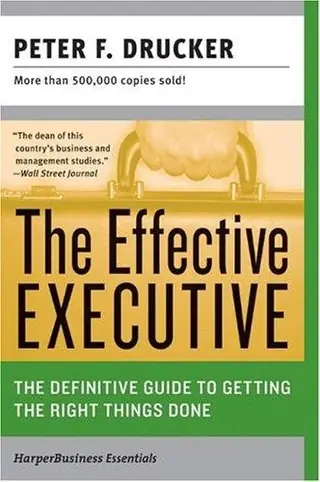
The Effective Executive summary
by Peter F. Drucker · 1966 · 7 key ideas · 17-minute read
Effectiveness — getting the right things done — isn't a talent but a set of habits anyone who does knowledge work can learn.
Why read it
For managers, professionals and anyone whose work is mainly thinking and deciding. Drucker's short classic is the foundation of modern advice on time, priorities, strengths and decisions.
The Effective Executive in brief
Drucker writes for a new kind of worker: the knowledge worker, whose output is ideas, information and decisions rather than physical goods. Anyone whose knowledge or position makes them responsible for contributions that affect an organisation's performance is, in his sense, an ‘executive’ — whether or not they manage anyone.
His central observation is that intelligence, imagination and knowledge are common, but effectiveness is rare. Many brilliant people produce little because they're busy with the wrong things. The good news is that effectiveness can be learned. It's a set of practices, not a gift.
He describes five habits. Know where your time goes. Focus on contribution — the results that matter outside your own job. Build on strengths, your own and others', rather than fixing weaknesses. Concentrate on a few major priorities and do first things first. And make effective decisions through a disciplined process.
The book is short, practical and full of examples from business, government and history. Its tone is demanding but encouraging: anyone willing to practise these habits can become far more effective — and organisations full of effective people achieve far more.
The 7 key ideas
1. Effectiveness can be learned
Brilliance is common; effectiveness is a habit.
2. Know thy time
You can't manage what you haven't measured — especially time.
3. Work in big blocks
Ten scattered hours are worth less than three whole ones.
4. Ask what you can contribute
Ask not what you're doing, but what you're contributing.
5. Make strengths productive
Hire for strength; arrange to make weakness irrelevant.
6. First things first — one at a time
Decide what not to do — then don't do it.
7. Decide with dissent
If everyone agrees, you haven't thought hard enough yet.
Read the full guide in Kinquire. Every idea with a real example, a diagram and one thing to try today, plus a quick quiz so it sticks. Free to start.
Read The Effective ExecutiveKey takeaways
- Keep an honest time log for a few days and cut what doesn't matter.
- Gather your free time into large blocks for important thinking.
- Ask what results others need from you, not just what your job says.
- Staff and delegate around people's strengths.
- Decide what to drop, not only what to prioritise.
- Welcome disagreement before making important decisions.
Our take
The Effective Executive is brief, clear and has aged remarkably well; most modern advice on time audits, deep work and strengths traces back to it. Its limits are those of its era. The examples are mostly from mid-20th-century corporations, governments and male leaders, and some feel distant now. It assumes people have meaningful control over their schedules and roles, which many workers don't. It also says little about emotions, wellbeing or team dynamics. Still, as a compact manual on how individual knowledge workers can get the right things done, it remains one of the best.
About Peter F. Drucker
Peter F. Drucker was an Austrian-born writer, consultant and professor whose books helped establish management as a field of study. He is widely credited with popularising the term ‘knowledge worker’.
If you liked this
- High Output Management by Andrew S. Grove
- Deep Work by Cal Newport
- Essentialism by Greg McKeown
- Good to Great by Jim Collins
- Built to Last by Jim Collins and Jerry I. Porras
- The Innovator's Dilemma by Clayton M. Christensen